State of Affairs with Steve Adubato
Addressing the prevalence of childhood poverty
Clip: Season 9 Episode 32 | 11m 6sVideo has Closed Captions
Addressing the prevalence of childhood poverty
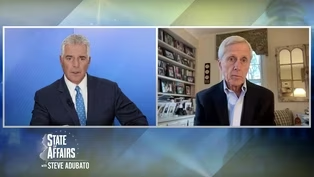
Peter Chen, Senior Policy Analyst at New Jersey Policy Perspective, joins Steve Adubato to examine the importance of addressing childhood poverty and the impact of the 2030 Census on families and communities.
Problems playing video? | Closed Captioning Feedback
Problems playing video? | Closed Captioning Feedback
State of Affairs with Steve Adubato is a local public television program presented by NJ PBS
State of Affairs with Steve Adubato
Addressing the prevalence of childhood poverty
Clip: Season 9 Episode 32 | 11m 6sVideo has Closed Captions
Peter Chen, Senior Policy Analyst at New Jersey Policy Perspective, joins Steve Adubato to examine the importance of addressing childhood poverty and the impact of the 2030 Census on families and communities.
Problems playing video? | Closed Captioning Feedback
How to Watch State of Affairs with Steve Adubato
State of Affairs with Steve Adubato is available to stream on pbs.org and the free PBS App, available on iPhone, Apple TV, Android TV, Android smartphones, Amazon Fire TV, Amazon Fire Tablet, Roku, Samsung Smart TV, and Vizio.
Providing Support for PBS.org
Learn Moreabout PBS online sponsorship[INSPRATIONAL MUSIC STING] - Hi, everyone, Steve Adubato.
We kick off the program with Peter Chen, Senior Policy Analyst at New Jersey Policy Perspective.
Peter will put up the website for New Jersey Policy Perspective, let everyone know what it is?
- Sure, New Jersey Policy Perspective is think tank.
We're dedicated to advancing social, economic and racial justice in the State of New Jersey through database analysis and research.
- Let's talk about childhood poverty first.
How do we define it?
How serious is the problem?
What do we need to do, please?
- Sure, so, child poverty in New Jersey is a serious problem.
One in eight New Jersey kids live in poverty.
And just to give some context for what that means, if we're talking about a family of four, we're talking about less than $30,000 a year.
And when you think that the median income in New Jersey is around $100,000 a year, that's a very small amount of money to be raising kids.
And the kinds of experiences that they can have would be, can be hampered by their life in poverty.
- What does a new governor, Mikie Sherrill need to do to address along with the legislature and her cabinet, what does she need to do to address the issue?
- Addressing child poverty requires thinking big.
This is not an issue that can be solved by nibbling around the edges.
We saw with the expanded federal Child Tax Credit during the pandemic that this, you know, a substantial investment in children and families can cut child poverty by 40%, 50%.
But that requires real commitment on the part of lawmakers.
And that federal expanded Child Tax Credit went away, and many of the benefits went away as well.
And so what we need to see is some real focus on poverty as a serious issue rather than, as, you know, a nice to have kind of issue.
When we talk about affordability, we've heard over and over, affordability this and affordability that, affordability for children living in poverty is going to be the toughest, right?
The cost of rent, the cost of food.
- That's right.
- Those costs are higher for people living in poverty because they take up a bigger chunk of their income than they do for higher-income folks.
- But, Peter, lemme follow up on this because there's federal policy that impacts childhood poverty, SNAP, right?
Otherwise known as food stamps previously.
Medicaid funding being cut, whole range of federal programs.
What exactly can a state government do with federal government policies impacting in some ways, by the opinion of many in a negative way, children suffering of poverty?
Where's the state?
Where are the feds?
- I think one thing that we've seen is that it's important for states to have their own programs in order to help children and families.
And that relying on the feds is not necessarily a long-term solution where there is so much volatility and dysfunction in D.C.
And so for example, when the federal Child Tax Credit, the expanded version expired, New Jersey created its own Child Tax Credit, right?
Which now provides up to $1,000 for families with kids younger than age six.
So, you know, there are ways that states can try to reduce or eliminate poverty for their own residents.
Certainly New Jersey has a long history of this with its own state-Earned Income Tax Credit, which dates back to I think the Whitman administration.
- You've said that one of the ways to address childhood poverty is to give childhood allowance of $5,000 per child.
What's it now?
- Well, right now no state has a child allowance of the type that we're describing in the- - What would the 5,000 do in your opinion?
- Well, so we looked at some research from our national partners at the Institute on Taxation and Economic Policy as well as work that was done in the wake of the federal expanded Child Tax Credit.
And there were some estimates done to try to see what would take to reduce child poverty by half by state?
And in New Jersey, that number was in the 4 to $5,000 range.
And you know, it seems like an appropriate figure given that the cost of living in New Jersey is higher than in most other states.
- Let's shift gears.
The folks at The Fund for New Jersey.
We've had conversations with Brandon McKoy, the other leaders there about the importance of the census.
There's a 2030 census coming up.
The federal government has the responsibility to count the number of people living in a state, correct?
- That's right.
Yep, it's in the Constitution.
- It's in the Constitution, but how it gets done, exactly when it gets done is now being discussed and debated by some.
But let folks know why the 2030 census is so critically important to the 9.5 million people in the State of New Jersey, particularly the most vulnerable.
- So, there are three main ways that the census is really critical for states and for people in general.
The first is redistricting.
The reason why we have a census, the reason why it's in the constitution is to divide up the districts for legislative and Congressional districts to determine how many Congressional Representatives we have.
New Jersey did not lose a Congressional Representative in the most recent census, which is good for us 'cause it means one more voice in D.C.
speaking- - Well, hold on, lemme clarify something.
There's a set number of members of House of Representatives.
There's 435 members in the House of Representatives.
Doesn't go up, doesn't go down, it apparently, not apparently, the fact is New Jersey has lost House seats in the past because of a loss of population.
Or even if the population that stays the same in other states, Texas, California and others gain population, they have more representation.
That's where it starts.
The legislature has a set number of members in the House, the lower house and the Senate.
But it moves, you don't lose representation in the legislature, but districts get moved around?
- That's right, the borders of districts get moved around, because each district needs to have a roughly even number of people.
But in New Jersey, those State legislative district lines can't go across town boundaries other than Jersey City and Newark.
So, when the census happens, they have to redraw those district lines.
And some districts may shift who their representative is.
Some districts, some towns that may have had an outsize influence on one district may find themselves in a new district.
And so that can definitely affect how political power is divided up across the state.
- If it shifts power around, that's one thing, but we're a policy-centric media series.
How does that potentially impact policy?
- Well, I mean, every time there's a shift in the borders of political boundaries, there's going to be a shift in what political leaders are going to focus on.
We have, for example, you know, real assaults going on on the Voting Rights Act and on the way that legislative districts are drawn to protect Black and Hispanic populations.
And that's, you know, all going into the next cycle and having an accurate account of where people actually live and, you know, who they are is critical to ensure that, you know, those boundaries represent the voice of the people of New Jersey.
- And by the way, team, let's make sure we put up a website so that people can find out more about what the census is, how it works, and why it matters.
Have about minute left.
Let me ask you this, Peter, for the new governor in the State of New Jersey, Christie Whitman, excuse me, Christie Whitman.
We were just doing another segment on the last female governor in the State of New Jersey who was in fact Christie Whitman, the first Democrat, the first woman to be a Democrat and be elected is in fact Mikie Sherrill.
What would you say the number one or two issues she will face as governor when she takes office in January?
What do you believe they are, Peter?
- I think one huge issue is the fiscal state of the state budget.
There are serious landmines waiting for the next governor in the upcoming budget.
Whether it's the traumatic cost increase in State New Jersey, increasing healthcare costs, increasing school funding costs, and a structural deficit that is going to continue to eat away at the state's cash reserves.
And that's gonna make it very challenging to take on new projects, to make the kind of ambitious investments that the state needs.
And for that, the new governor is going to need new revenue.
And finding new revenue in New Jersey is always a challenging topic, but there are ways to ensure that more revenue can be raised without affecting most of the majority of people who live here.
But the second thing that I think is going to be facing the new governor is something that both candidates mentioned on the campaign, which is affordability.
- That's right.
- The costs of living in New Jersey particularly housing, are extremely high and they make it incredibly difficult for raising a family.
Even for folks who do wanna live here, who wanna stay here, who wanna raise a family they can't afford to, because they're getting priced out with rents, you know, skyrocketing and house prices skyrocketing as well.
So, I think addressing affordability with the kind of investments directly in families that can help alleviate those costs is going to be extremely important moving forward.
- And we look forward to an in-depth one-on-one interview with Governor Sherrill around a whole range of issues that Peter is discussing and others.
And make sure you go to the New Jersey Policy Perspective website to find out more.
Peter, thank you so much for joining us.
We'll talk in the future.
- Thanks, Steve.
- You got it, stay with us, we'll be right back.
- [Narrator] State of Affairs with Steve Adubato is a production of the Caucus Educational Corporation.
Funding has been provided by The Fund for New Jersey.
The Turrell Fund, a foundation serving children.
Garden State Initiative New Jersey Board of Public Utilities.
PSEG Foundation.
Holy Name.
The Adubado Center for Media Leadership.
Seton Hall University.
And by Robert Wood Johnson Foundation.
Promotional support provided by Insider NJ.
And by NJBIA.
- At the New Jersey Board of Public Utilities, affordability is always top of mind.
We offer a variety of energy assistance and other programs to help New Jersey residents reduce their energy use and save money.
The Community Solar Energy Program delivers immediate electric bill savings to all subscribers regardless of income, and our free Comfort Partners program helps qualified residents save money and make energy efficient upgrades.
We work to put affordability within reach for New Jersey residents.

Exploring the societal challenges associated with aging
Video has Closed Captions
Clip: S9 Ep32 | 7m 39s | Exploring the societal challenges associated with aging (7m 39s)
The impact of news deserts on democracy & local communities
Video has Closed Captions
Clip: S9 Ep32 | 9m 56s | The impact of news deserts on democracy & local communities (9m 56s)
Providing Support for PBS.org
Learn Moreabout PBS online sponsorship
- News and Public Affairs

Top journalists deliver compelling original analysis of the hour's headlines.

- News and Public Affairs

FRONTLINE is investigative journalism that questions, explains and changes our world.












Support for PBS provided by:
State of Affairs with Steve Adubato is a local public television program presented by NJ PBS