State of Affairs with Steve Adubato
Asw. Ellen Park; Sen. Declan O’Scanlon; Benjamin Dworkin
Season 8 Episode 10 | 27m 11sVideo has Closed Captions
Asw. Ellen Park; Sen. Declan O’Scanlon; Benjamin Dworkin
Asw. Ellen Park (D), 37th Legislative District, discusses regulating deepfakes and the revised Open Public Records Act. Sen. Declan O’Scanlon (R), Republican Budget Officer, addresses his concerns about the New Jersey Fiscal Year 2025 Budget. Later, Benjamin Dworkin, Ph.D., Director of Rowan Institute for Public Policy & Citizenship, discusses youth voter engagement.
Problems playing video? | Closed Captioning Feedback
Problems playing video? | Closed Captioning Feedback
State of Affairs with Steve Adubato is a local public television program presented by NJ PBS
State of Affairs with Steve Adubato
Asw. Ellen Park; Sen. Declan O’Scanlon; Benjamin Dworkin
Season 8 Episode 10 | 27m 11sVideo has Closed Captions
Asw. Ellen Park (D), 37th Legislative District, discusses regulating deepfakes and the revised Open Public Records Act. Sen. Declan O’Scanlon (R), Republican Budget Officer, addresses his concerns about the New Jersey Fiscal Year 2025 Budget. Later, Benjamin Dworkin, Ph.D., Director of Rowan Institute for Public Policy & Citizenship, discusses youth voter engagement.
Problems playing video? | Closed Captioning Feedback
How to Watch State of Affairs with Steve Adubato
State of Affairs with Steve Adubato is available to stream on pbs.org and the free PBS App, available on iPhone, Apple TV, Android TV, Android smartphones, Amazon Fire TV, Amazon Fire Tablet, Roku, Samsung Smart TV, and Vizio.
Providing Support for PBS.org
Learn Moreabout PBS online sponsorship- [Narrator] Funding for this edition of State of Affairs with Steve Adubato has been provided by Hackensack Meridian Health.
Keep getting better.
Veolia, resourcing the world.
Operating Engineers, Local 825.
IBEW Local 102.
Lighting the path, leading the way.
Eastern Atlantic States Regional Council of Carpenters.
New Brunswick Development Corporation.
PSE&G, powering progress.
Horizon Blue Cross Blue Shield of New Jersey.
Here when you need us most.
And by Johnson & Johnson.
Promotional support provided by New Jersey Globe.
And by The New Jersey Business & Industry Association.
[INSPRATIONAL MUSIC] - Hi, everyone.
Steve Adubato.
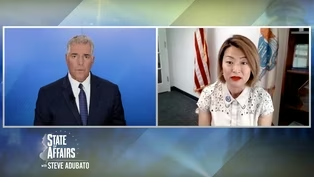
We kick off the program welcoming back to the program Assemblywoman Ellen Park, a Democrat from the 37th Legislative District in Bergen County, right, Assemblywoman?
- Correct.
Good morning.
- Great to see you.
We are taping in the morning.
Put this in perspective for us.
What is the New Jersey Asia-Pacific Center in Taiwan and why is it related to New Jersey?
- So, there's a not-for-profit called Choose NJ that is basically branching outside of New Jersey and to countries in Asia as well as all of Europe to basically let people outside of New Jersey, around the world know what a great place to have a business here in New Jersey.
So Taiwan, Taipei, Taiwan, is going to be the hub office for offices throughout Asia.
So there are offices as well, satellite offices in Korea, Japan, China, but Taipei, Taiwan is going to be the hub of all the offices in East Asia.
- That's important, and for the folks at Choose New Jersey, we're gonna put up the website of Choose New Jersey right now so people can find out more about the New Jersey Asia-Pacific Center in Taiwan.
So let's shift gears Assemblywoman.
You've been very involved in what's called deepfakes.
- Yeah.
- Confronting, dealing with, proposing legislation that, what the heck is?
I think I know what a deepfake is.
Again, what it's going on in terms of technology today.
It's helpful and dangerous at the same time.
- Absolutely.
- What is a deepfake, A, and B, what is your legislation doing to confront this serious problem?
- A deepfake is, you know, I guess in the simplistic form is let's say I use your face on an image that's not actually you.
So people who are looking at it think it's actually you, but it's somebody else's body or someone else in a video, and they basically just use your imagery to say that that is you.
So, especially when it comes to elections moving forward, we have these deepfakes that can mimic the President or a candidate, but it's not them, and it's really important that we have disclosure saying that the depicted image is actually not real.
- Where is that?
Does that go on the bottom of the screen, Assemblywoman?
- That will be on the bottom of the screen, correct.
So, that's- - And why is this particularly a problem with younger people?
- Again, I think it's mostly younger, especially elderly.
You know, we were just talking about this the other day in my home.
I'm not gonna name who, but one of our elders in our family saw a video where they trained giraffes to jump off a diving board and they're swimming in a lake or a pool, and my kids thought it was really funny that my family member thought that that was real, but it's not, clearly.
It's just, it's fake.
It's fake AI, and there's so many images out there that are fake.
Especially there was that incident in a Jersey high school where they used this poor girl's face and put it on some pornographic material.
And again, there has to be repercussions and we need to tell the public what is real and what is not.
- You know, what's so crazy about, I didn't think I would be disclosing this, but I told one of our colleagues this on our team who helped take this down, but someone came to me and said, this is gonna sound nutty, right?
Said, "Do you know that you're on Bumble?"
So I said, "Wait, I'm on Bumble?"
- Right.
- Now, I don't think, my wife and I don't have that.
So I said, "Where is it?"
And so someone showed me the picture, and it was someone who used a picture from on camera.
I didn't think it was a particularly good image of me, but more importantly said "John Smith."
The age was younger, which I liked.
- Right.
- I showed it to my wife and we couldn't stop laughing.
And I thought someone for some ridiculous reason, who knows why, used an image of me from the air on Bumble with a different name.
Is that a deepfake, A, and B, would it be required in your legislation that someone says, "This isn't really Steve Adubato.
"This is a deepfake."
- Yes, that's the goal, but of course on a personal account, it's a little different.
But at least for the starting off to ask for the media and anything that's publicated, anything on TV, we're definitely going to have a disclosure saying that the depicted image is not a real image.
- Yeah, and by the way, I just wanna confirm, not on Bumble, which is a dating site Not on it.
- Right, right, right.
- I'm just clarifying, Assemblywoman, okay?
Let's try this.
I'm curious about this, and I just told you before we got on the air that every member of the legislature, Democrat, Republican, every significant public official from my view needs to be asked this question.
The New Jersey Open Public Records Act has recently been changed.
The governor signed, Governor Murphy signed legislation to change it.
Some people have argued that what the governor did by signing this legislation, which most legislators voted for, which is why it got passed and went to the governor, that it's made it harder for people to access public records, to access votes that legislators have taken, that local government officials have taken, that all kinds of things that happen in local community school boards.
Did you abstain on that vote?
- I did.
- Why?
- And the reason why is I'm actually really split down the middle.
I'm torn.
I've had personal experiences on both sides.
So, I actually sued my former mayor for information, and as a council person, I really didn't need to sue him for OPRA.
But instead of giving our party- - OPRA is the Open Public Records Act.
- Correct.
- That is the acronym for it.
Go ahead.
I apologize, Assemblywoman.
- That's okay.
So instead of giving us the materials, right, we're in different parties, he said, "OPRA them," which that was my only recourse at the time, right?
So I did OPRA them and he still didn't give it to me, and of course we sued, and it took years to get this emails that we're searching.
And of course, these emails were given to his party that were sitting members on the council, whereas our party didn't get any emails, so I'm on that side.
And then the other side is someone OPRA'ed all of my building permits when I was renovating my home.
And of course- - You private home?
- Correct.
And they used it against me.
You know, the other party used it against me to say that I did some sort of wrongdoing, which they hired an outside inspector from another town and he came out and wrote a letter saying that I didn't do anything wrong and I followed protocols, but of course that was never released, right?
Instead they made this huge "majig" thing to do to basically try to tarnish my political reputation.
So I'm literally like down the middle when it comes to this issue.
And there are some very good things about the bill.
- Assemblywoman, hold on one second.
You're saying utilizing the Open Public Records Act, otherwise known as OPRA, can be abused, is your argument?
- Absolutely, and I'm saying that I have not been given records that I should have gotten, and the flip side is people have gotten records that had nothing to do with anything in order to use it against me.
So I'm not sure even why- So this is not a black and white issue.
- I'm sorry.
- Sorry, this is not a black and white issue for you, right?
- No, no, no.
- It's not so obvious.
- It's one of the reasons why I abstained, is I've been on both sides and I know how this works.
And so the proponents of this bill, there are some good things about this bill, which is they're gonna make almost everything public so that you don't have to OPRA that, right?
And then you talk about technology, right?
Things that you should be able to get with the click of a mouse, it's going to be on the website for the municipalities that have the technology.
The flip side of it is we're talking about I think the biggest issue was the fee shifting, right?
Is that when you hire an attorney to sue for ORPA, if they prevail, then they will get paid for their time, and which that was the case for me.
I hired an outside attorney, we prevailed.
He got paid, right?
And from what I hear as well, and it's not Bergen County, but there are other counties where this is also getting abused, a couple of attorneys have made a career out of getting these, suing for OPRA.
And so I think we have to see how this goes.
Let's see what happens.
If we need to amend the bill, we'll come back and amend the bill, but I definitely believe that there needs to be some OPRA regulation.
- Assemblywoman, we appreciate you joining us and speaking candidly about a whole range of issues.
I wish you all the best.
Thank you.
- Thank you.
- Stay with us.
We'll be right back.
(grand music) - [Announcer] To watch more State of Affairs with Steve Adubato, find us online and follow us on social media.
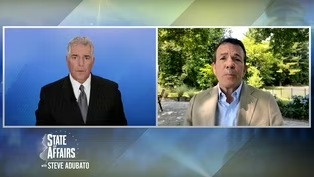
- We're now joined by State Senator Declan O'Scanlon, the Republican Budget Officer in the State Senate.
Good to see you, Senator.
- Good to see you, Steve.
How are you?
- I'm great.
Well, listen, we're taping on the 17th of June.
It'll be seen after the budget in New Jersey will officially be in place by the end of the month hopefully.
What's your biggest concern about this budget?
Be specific, please.
- My specific, my most specific concern is the $4 billion structural deficit that this budget leaves us with.
It is really terrifying and it sets us up for failure very quickly once this governor leaves office.
The Murphy administration's gonna go down as the administration of the most tragically missed opportunities.
We could have substantially fixed our budget over this past five or six years with all the billions of dollars of federal money we had, the billions of dollars of unnecessarily borrowed money that we borrowed.
We could be and we could have reworked the school funding formula.
It is tragic that we didn't, and we are really set up for failure here.
It's very easy to illustrate this $4 billion structural deficit that we have.
We're spending down $2 billion and this is a time of decent revenues, $2 billion of our surplus, it's going from eight to $6 billion.
We have a billion dollars of additional taxes with the CBT that the transit fee.
- Hold on, hold on.
You said the CTT?
- CBT, Corporate Business Tax, sorry.
- Corporate Business Tax, okay.
And what's your issue with that?
- My issue with that is that that money isn't going to transit as the governor has said he wants to do.
- New Jersey Transit?
The governor said it was going to New Jersey Transit.
- It's not.
None of it is going, this year.
- It's going to the general fund and then to New Jersey Transit.
- No, it's not even going to New Jersey Transit at all this year.
It's going to the general fund.
That is a billion extra dollars of structural deficit, right there, gets you to three.
Then they're stealing over almost $600 million of debt.
- Senator, do you wanna use the word stealing?
Do you wanna use the word?
- I do, I do.
When you say you're going to use money to defease debt and avoid other taxes, yet you're taking it and putting it in the general fund.
Yeah, I can use the word stealing.
Same thing with the transit fee by the way.
It sets us up to, again, we're taking our surplus from 8 billion to 6 billion this year and we're leaving ourselves with a $4 billion structural deficit.
That means in a year and a half that the surplus is gone.
If we have a, and that's with decent revenue figures.
If we have a downturn, it's a disaster.
What's the next governor gonna be facing in January, 2026 where he or she takes office?
- He will probably be faced with almost no surplus.
And runaway spending that we've put into place that it'll be very hard to claw back.
We had a historic opportunity to remake our school funding formula.
This governor put 3.5 billion extra dollars into school funding during his tenure.
Had we nearly put 2.5 billion in, we could have reduced our structural deficit by a billion.
Been more responsible with that spending, given plenty of money to the districts that deserve more, and avoided the cuts to the ones that are really tragically being cut to the point where they're losing quality education.
We could have avoided all of that.
- So, hold on.
You're saying state funding to local public school districts.
The school funding formula, if you will, which has not been changed in a long time.
In your district in particular, Senator, are there specific school districts that are getting less state aid, therefore are cutting teachers, program, services?
- My district did okay this year.
Last year was devastating.
Next year maybe, but my concern for the school children of New Jersey doesn't end at my district.
In Monmouth County, with devastating cuts to these districts it is a disaster and totally, totally unavoidable and should have been.
The school funding formula could- - Why do you think the governor would do that?
But is it the formula that does it, Senator, or the governor's discretion?
Like how does that happen?
- The formula is the governor.
The formula is at the discretion of the governor every time he does a budget.
The formula is at the discretion of the governor to lead and realize that the formula was unattainable and pie in the sky and would put way too much money into education, 'cause that can happen.
We already, even before he put this extra money in, spent more money on education than almost any other state in the nation.
And they were putting out as good or better a product, many of them.
So the formula isn't separate from the governor.
He is not handcuffed by it.
If he were to lead four or five years ago, start an effort to redo the school funding formula, we would be in a dramatic better place today.
Instead, he just blindly followed the existing formula, 'cause we had so much money in our laps that was non-recurring and now we're stuck with it.
It is a missed opportunity of colossal proportions.
- The standard bearer of the party that you're a member of, the Republican Party, former president Donald Trump talks about what his administration would be like if he were elected again.
And by any reasonable standard, it's hard to hear a lot of policy discussion.
A lot of it is about a two-tiered system of justice and that the Biden corruption, the Biden crime family, and that he, former president Trump, was railroaded in his trial.
To what degree do you believe that President Trump?
Well, lemme ask it this way.
How comfortable are you with President Trump being the standard bearer, the leader of the party, Republican party that you're a part of?
- Look, I made it clear, Donald Trump was not my first choice to be the nominee.
I made that clear.
But he is the nom, and we have to choose between a Trump administration and a Biden administration.
And in that choice, that binary choice, it's not hard to decide.
- It's not hard?
- Ultimately, it's not, the Biden administration- - Even after January 6th and the president, former president saying that he would, pardon, first day, he would immediately pardon those who were involved in this insurrection January 6th.
Easy choice?
- I look, I disagree with that.
I disagree with many things that President Trump has said he will do.
But I don't have a choice other than two of these choices.
And the Biden administration has been a disaster for this country.
So those are our choices, Steve.
I made an argument to make other choices.
I did not win that battle.
Now we are faced with the choices that we have and to go through another four years of a Biden administration scares the hell outta me.
Am I concerned with some of the things that President Trump has said he will do?
I am.
And I will be a voice within the party to moderate some of those actions.
And I think there'll be other voices, too, that I think will inform the Trump presidency and certainly filter out some of the things that we, paths we shouldn't go down, but make it a better administration from policy perspective than a Biden administration could hope to be.
- State Senator Declan O'Scanlon, the Republican Budget Officer, an important voice in the state of New Jersey.
Thank you so much, Senator.
Appreciate it as always.
- Thanks Steve.
- Stay with us, we'll be right back.
(grand music) - [Announcer] To watch more State of Affairs with Steve Adubato, find us online and follow us on social media.
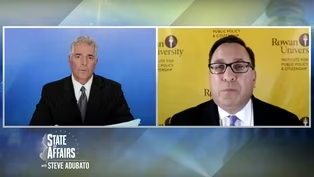
- We're joined once again by our good friend down in South Jersey, Dr. Ben Dworkin, director of the Rowan Institute for Public Policy and Citizenship, Rowan, one of our higher ed partners.
Good to see you, Ben.
- Good to see you, Steve.
Thanks so much for having me on.
- Hey, Ben, can we do this?
The graphic will come up right away, Democracy in Danger.
Why the heck do you think so many people don't trust the outcome of an election and think it's rigged?
Not a hard question, right, Ben?
- Look, I think there are a lot of reasons.
I mean, among the biggest ones is that all the incentives it seems for both politicians and certain elements of the media are geared towards dividing.
They're geared towards a quick-paced, very increasingly, very speed-oriented.
Things have to be faster and faster, and you have to keep people's attention because they move away.
And I think politicians have found that they raise money, they get elected if they question the system.
And there are folks in the media who have made billions doing that exact same thing, exploiting those kinds of divisions.
And when you hear over and over again that the system can't be trusted, then you are ready to question even the outcomes of an election.
Despite all the investigations, despite all of assurances that might have been given, nobody can be trusted, and therefore the outcome can't be trusted.
It's a very unfortunate situation, obviously.
- So as you're promoting citizenship and understanding of public policy down at Rowan, at the Institute for Public Policy and Citizenship, what is your sense from most young people, college students you interact with, as it relates to their view of, let's talk about this presidential election.
Do you believe that more young people will actively participate and vote this year or not?
- As compared to four years ago?
- Say four years ago, eight years ago.
Do you think more will participate?
- It's unclear.
Probably not, because neither candidate, as we've seen in polling, and this is not just for younger voters, say, under the age of 29 or under the age of 24, but across all age demographics, a lot of people aren't particularly inspired by either candidate.
You know, presidential elections are about the future, and Donald Trump very much wants to talk about the past and his grievances.
And Joe Biden, simply because of how he looks physically, becomes a very difficult avatar to use to talk about the future.
And I think, you know, for both of those reasons, we're having a hard time inspiring people despite the tremendously high stakes in this election.
- President Biden, 81 right now, will be, if elected, 86 on the backend.
President Trump, as we do this program, just turned 78.
But age is a relative things, and people present differently at different, at certain ages, and it's not all the same.
And a lot of this is a question of perception, Professor.
Is that fair to say?
- Absolutely.
It's how we look at people.
And it's hard.
There are lots of people who understand.
We know other 81-year-olds, we know other 78-year-olds.
We work with them, they are colleagues, and they do a fine job, and these guys are gonna have to present themselves.
But the question about whether are people going to be inspired in a positive way to rally around either of these two candidates, when you're talking about the younger generation, that's gonna be hard to come by.
-The Open Public Records Act, otherwise known as OPRA, it has been changed significantly based on a law that was passed or a bill that was passed, signed into law by Governor Murphy.
There are some who have argued that it is less transparent, that it's gonna be harder for citizens, others to get access to government information or information about government actions, activities, emails, memos, et cetera, fiscal details.
Do you believe it was a mistake on the part of the governor to sign that bill, Professor?
- I don't know- - Or the implications of what happened?
- Yeah, I think it's too early to say whether it was a mistake, both from a policy perspective and a political perspective, but I can say this.
I think this is one of those issues that Trenton sometimes think the public isn't paying attention, but come election time, they will.
Openness in government record-keeping, the ability to find out what your government is doing, especially in a world in which people are less trusting of government, is not something that should be restricted.
That there were plenty of policy reasons.
The proponents of the reforms for the Open Public Records Act said, "We need to make these changes.
We need to update things."
There were abuses that were being faced.
But when you start closing off abuses, you also close off opportunities for very legitimate inquiring by the public, by members of the media that have yielded tremendous fruit in terms of understanding what is going on.
So I think the public understands the issue.
I imagine that come 2025, and we have our legislative elections as well as a gubernatorial election, reforming OPRA is gonna be a major issue and certainly an attack line that folks who are challenging incumbents who supported the bill are gonna be using and using effectively because the public basically gets it.
- In that spirit of disclosure, I just wanna reiterate that Rowan University is a higher ed partner of ours, an underwriter of our programming, to make sure we fully disclose because it's not just important for government, it's important for media as well.
Real quick on this, Ben.
2025, we're doing all these interviews, policy-oriented conversations with every candidate for governor.
Top two or three policy issues that you think, beyond this transparency issue with OPRA you just talked about, what are the policy issues that you believe will matter most to voters in 2025, please?
In the state.
- Sure.
Number one, far and away, is going to be affordability.
Writ large, that is it.
Now, under the issue of affordability, comes a lot of different things.
We're talking about property taxes, which, in terms of specific issues, is higher than any one else.
Almost 40% of the public says that property taxes are their number one issue, and this is very consistent with the kinds of polling that we've seen for decades.
- And state funding?
State funding of local schools will matter as well?
- Well, that relates to state funding of local schools.
- Affordability.
- Becomes part of affordability.
Exactly.
When the state is subsidizing your property taxes, you don't pay as much for your schools because the state is kicking in money.
So how much the state is kicking in and how that formula gets, how that money gets distributed will be a key issue in making your life affordable.
- Professor Ben Dworkin helps us understand a whole range of public policy issues.
He's the director of the Rowan Institute for Public Policy and Citizenship.
Ben, as always, thank you, my friend.
- Thank you so much, Steve.
- I'm Steve Adubato, that's Professor Dworkin.
We thank you so much for watching, and see you next time.
- [Narrator] State of Affairs with Steve Adubato is a production of the Caucus Educational Corporation.
Celebrating 30 years in public broadcasting.
Funding has been provided by Hackensack Meridian Health.
Veolia, Operating Engineers, Local 825.
IBEW Local 102.
Eastern Atlantic States Regional Council of Carpenters.
New Brunswick Development Corporation.
PSE&G, Horizon Blue Cross Blue Shield of New Jersey.
Johnson & Johnson.
And by these public spirited organizations, individuals and associations committed to informing New Jersey citizens about the important issues facing the Garden State.
Promotional support provided by New Jersey Globe.
And by The New Jersey Business & Industry Association.
(Sounds of Water) - (Narrator) Most people don’t think of where there water comes from.
But we do.
Veolia, more than water.
Resourcing the world.
Asw. Park on the Open Public Records Act & Regulating AI
Video has Closed Captions
Clip: S8 Ep10 | 10m 16s | Asw. Park on the Open Public Records Act & Regulating AI (10m 16s)
The Importance of Youth Voter Engagement in New Jersey
Video has Closed Captions
Clip: S8 Ep10 | 9m 8s | The Importance of Youth Voter Engagement in New Jersey (9m 8s)
Sen. O’Scanlon Examines the NJ Fiscal Year 2025 Budget
Video has Closed Captions
Clip: S8 Ep10 | 8m 47s | Sen. O’Scanlon Examines the NJ Fiscal Year 2025 Budget (8m 47s)
Providing Support for PBS.org
Learn Moreabout PBS online sponsorship
- News and Public Affairs

Top journalists deliver compelling original analysis of the hour's headlines.

- News and Public Affairs

FRONTLINE is investigative journalism that questions, explains and changes our world.











Support for PBS provided by:
State of Affairs with Steve Adubato is a local public television program presented by NJ PBS