
Demystifying Pathological Demand Avoidance (PDA)
Season 2025 Episode 9 | 26m 46sVideo has Closed Captions
Michigan’s Lozen family; Ask the Experts; Difference Maker actor/advocate Patrick McKenna.
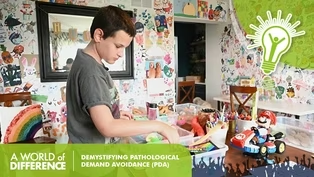
A Michigan family embraces low-demand parenting, discovering how easing expectations can unlock connection and growth. Experts unpack the science, debate, and lived realities behind PDA. Plus, meet Patrick McKenna, an actor and ADHD advocate whose candid voice is helping families feel seen.
Problems playing video? | Closed Captioning Feedback
Problems playing video? | Closed Captioning Feedback
A World of Difference is a local public television program presented by WUCF
Demystifying Pathological Demand Avoidance (PDA)
Season 2025 Episode 9 | 26m 46sVideo has Closed Captions
A Michigan family embraces low-demand parenting, discovering how easing expectations can unlock connection and growth. Experts unpack the science, debate, and lived realities behind PDA. Plus, meet Patrick McKenna, an actor and ADHD advocate whose candid voice is helping families feel seen.
Problems playing video? | Closed Captioning Feedback
How to Watch A World of Difference
A World of Difference is available to stream on pbs.org and the free PBS App, available on iPhone, Apple TV, Android TV, Android smartphones, Amazon Fire TV, Amazon Fire Tablet, Roku, Samsung Smart TV, LG TV, and Vizio.
Providing Support for PBS.org
Learn Moreabout PBS online sponsorship(bright upbeat music) >>Welcome to "A World of Difference: Embracing Neurodiversity."
I'm Darryl Owens.
Into every parent's life, a child will eventually say the word no.
It's expected, developmental, and usually short-lived.
Except when it isn't.
For a growing number of parents, "no" becomes the soundtrack of daily life.
Even simple requests, getting dressed, starting homework, brushing teeth can spark intense resistance.
Many families are now turning to a term they feel captures this extreme persistent pushback, pathological demand avoidance, or PDA.
Yet PDA is controversial.
It isn't an official diagnosis and experts debate whether it reflects a distinct autism profile or a child's attempt to cope with overwhelming anxiety.
But families living this reality share a truth.
Their children aren't trying to be difficult, they're trying to feel safe.
And when parents shift from a "you have to" to a "how can we make this doable" approach, conflict eases and connection grows.
On this episode, we traveled to Michigan to meet the Lozen family who have embraced low-demand parenting and discovered that reducing pressure can open doors.
Three national experts help us untangle the controversy, the science, and the lived experience behind PDA.
And in our latest Difference Maker segment, we spotlight actor and advocate Patrick McKenna, whose honesty about ADHD has helped countless families feel seen.
While parents often joke that they wish their child came with an instruction manual, Phil and Amy Lozen quickly learned that nothing prepared them for their son Ben's intense reactions to everyday requests.
What began as simple objections spiraled into excuse-making, distractions, withdrawal, escape attempts, meltdowns, or full-blown panic attacks.
And there was nothing funny about that.
When traditional approaches fell flat, the Lozens made a bold shift, low-demand parenting.
They transitioned Ben to online school, built scaffolds around his strengths, and eased the pressure that triggered shutdowns.
They learned to follow Ben's cues, not to fight them, to collaborate rather than coerce.
And in that shift, they found connection, clarity, and the key to unlocking their son's potential.
(upbeat music) >>We knew he was autistic, but nothing was helping.
Like, the traditional therapies that people do for autism, it wasn't working.
>>You might go through life and have a day where you're like, I just don't have the bandwidth to put up with X, Y, or Z, right?
But we can overcome that.
We can have bad days, we can have days where we can.
His nervous system is always engaged in that high bandwidth state.
So, what we kind of feel when we have days like that sometimes, he's always there.
So, that makes it much easier for him to, you know, go into burnout, go into a meltdown situation or something like that.
And those can take a lot of different forms, really.
>>I feel like learning what PDA was and how the nervous system came into play and how everything was brain-based and not behavior-based just absolutely changed everything.
It changed our whole experience of parenting.
And it quickly changed how we parented him, and then how he was responding to things.
>>I wish I didn't have the disability.
It's very hindering, that's how I say it, hindering to my regular life because I just have a bunch of meltdowns.
A random meltdown.
>>So, Willow Integrated Therapy is a speech and OT place, a clinic in Ann Arbor that we go to for occupational therapy.
>>New update chart.
>>New updated chart.
Let's check it out.
Things are going up pretty fast.
I noticed these two are going up.
So, PDA, pathological demand avoidance, or persistent drive for autonomy is sometimes a little lighter version of it.
When someone can sense or perceive that maybe someone is over them, so, think of authority figures, like teachers, parents, even therapists, or Ben's case, like school and police officers and law enforcement, they can feel threatened.
I think just having a safe place where he can be himself and I can kind of explore with him what his inner world is, it's been really awesome.
Because I think there's a lot under the surface that people wouldn't recognize if you were just watching him on the street.
But there's a lot of thoughts and feelings and processes down under that you can tell he's working really hard to be able to access and work through.
>>Okay, I'm gonna castle.
>>You can't, it's my turn, Ben.
Ben.
>>Okay, I will not castle.
>>He's just like so smart.
He is so, like, the other day we were in the car just talking about geography and he listed all of the countries in Europe in alphabetical order and what their histories of regime changes had been.
And I was sitting there, like, occasionally, I was like, oh yeah, I know that.
Or I didn't know that.
But he steals the show.
He knows so much about these things that he's interested in and he just spends so much time in these fields.
It's really impressive.
>>The thing that mainly changed for me was learning how to accommodate for him.
So, when I was younger, it was a lot easier to pick fights with him or be upset about the kind of stuff, that like, if he gets upset, like I would just get upset back.
But the older I get the more I have to be like, okay, he needs different ways of like talking to, and so it's just having to learn and just work around it.
>>So, tell me about those ones.
>>Well, these are my F1 sets.
1, 2, 3, 4, 5, 6, 7, 8, 9, 10.
There are 10 of them.
>>So, I think when we stumbled upon, discovered low-demand parenting and some of the Instagram accounts that we learned from the researcher that lives in Michigan, that we learned from Dr.
Bowers, it just was so life changing that it wasn't really something we sat down and thought through, are we gonna do this?
It was like, oh look, if we do this, he's gonna be more regulated.
And it just went from there.
>>Low-demand is gonna be great for some kids.
Low-demand definitely will not work for some kids.
You know, there's kids that are gonna need more guidance and need more structure and need more framework.
So, it's about knowing your kids, knowing what they need, and then adjusting to a place where you're gonna be, number one, you're gonna be successful parenting, but number two, you're setting them up to be successful as well.
You're setting them up to feel, you know, am I loved, am I safe?
You know, those two kind of key things.
And that looks different for every kid.
It looks different here for every kid every day with what we do.
>>I get worried sometimes about when he goes out places or is out and around, I'm worried about how people will treat him.
I'm worried about very much.
I'm very worried about how the world will treat him because it's a pretty uncertain time, because I'm afraid that something's gonna happen.
But it's just kind of how, you know, it's the big brother thing.
>>You never know if you're gonna get it right.
You just do what seems to make sense and you hope and then you adjust and then you hope and then you adjust.
>>I'm really thankful that we found all of this and it's helped Ben immensely.
But it is really great to see his joy and see the things, you know, him and his dog, water play, boats, different things that make him so excited and happy.
It's really great to see.
(upbeat music) >>Next, three national experts join us to help decode PDA and offer strategies for creating calmer, more collaborative homes.
Dr.
Lauren Goldstein is a licensed psychologist and Founder of Gold Psych Services in Coral Springs, Florida, with a deep commitment to neurodiversity affirming care.
She specializes in neurodiversity assessment and leads support groups for parents of children with pathological demand avoidance.
Dr.
Roseann Capannahodge is a mental health expert and author of "It's Going to Be Okay."
She hosts a parenting podcast, "Dysregulated Kids."
A Connecticut certified school psychologist and board certified neurofeedback provider, she specializes in nervous system-based approaches that support children and teens with ADHD, autism, and anxiety.
Dr.
Melissa Walley Packwood is an accessibility advocate, learning specialist, and adjunct instructor at Beacon College in Florida, America's first accredited baccalaureate institution dedicated to educating students with learning and attention issues.
She supports neurodivergent students in their transition to college and careers through executive functioning coaching, Universal Design for Learning practices, and AI-supported skill building strategies.
She also provides professional development and conference presentations focusing on UDL and inclusive instructional design innovation.
And we're gonna begin our conversation with Dr.
Goldstein.
How do you differentiate PDA from oppositional defined disorder when conducting neurodiversity assessments?
>>This is such an important question, because on the surface, PDA and ODD can really look similar.
Both have the refusal, the defiance, the power struggles.
So, when I'm doing an assessment, I'm really looking at the root and the function of those behaviors.
With ODD, the behaviors are anger-based.
So, we see things like irritability, argumentativeness, even vindictiveness, and the emotional tone is resentful or hostile.
Whereas with PDA, the behaviors that look like defiance or argumentativeness, those avoidance behaviors, they're really rooted in anxiety.
So, I'm looking at a child's behavior to see what is that root and function of the behavior.
With a PDA child, I'm looking to see how they're perceiving those demands, which a PDA child perceives as a threat to their autonomy.
That kicks in their dysregulation in their nervous system, which sends them to fight or flight, fawn or freeze.
So, those behaviors, I'm not just looking at to check a yes or no box, is a child oppositional or defiant?
I'm looking at is it anger-based or is it a panic response to that perceived loss of control?
>>All right, thank you.
Dr.
Capannahodge, from a nervous system perspective, what's happening during a PDA meltdown as compared to a typical tantrum?
>>Well, a PDA meltdown versus a typical tantrum, they are different because in PDA, individuals perceive everyday demands as a threat and that means it activates our emotional centers in the brain, which is controlled by the amygdala, and they go into fight, flight, freeze or fawn and become super activated.
So, their goal is to avoid what is perceived as a threat.
Where with kids who have a tantrum, it's much more goal-oriented.
They want something and they have a tantrum.
So for example, I want a cookie, you say no and they get angry about it.
So that difference between the two is really about nervous system activation and somebody with PDA is in a constant activation.
>>All right, thank you.
Dr.
Packwood, can you tell us how Universal Design for Learning can help reduce the impact of demands for a student in a classroom setting?
>>Sure, UDL is a really great tool or strategy to use, especially for instructors.
Basically, it allows some flexibility.
With UDL, we're looking at how can we provide flexibility in how we present information, how students receive information, and how they give output to show what they know.
So, when you have that kind of flexibility built into your curriculum, it allows those who may struggle with certain types of activities, certain types of output, due to perhaps some learning disabilities or anxiety responses, it helps them to have options as well as time to go through those options and consider what works best for them and their learning style as well as their level of stress with each activity.
So for example, I might provide a menu of options that students can choose from.
For example, I might say, hey, if you want to share what you know about this topic to show that you are focused in class, I might provide options such as polls, discussion posts, or verbal communication in class.
I could also show an option such as, hey, would you like to write on this whiteboard that's handheld what your answer is?
Or use a card of some sort to show if it's yes or no when you reply to the answer?
That gives options so that the ball is in the person's court rather than the ball is solely in the instructor's court and more of a demand.
I will say that this works sometimes, not always, but it's our best shot at gaining some of that buy-in, some of that focus in class, but also getting to know what the student knows so that we can in fact grade them and say, yes, they know this information.
>>All right, thank you very much.
Dr.
Goldstein, can you share with us some of the misconceptions that parents bring to your PDA support groups and how you go about reframing their expectations?
>>Yeah, so I generally see two categories of misconceptions.
One is about the parents themselves and the other is about the child's intentions.
So, for parents themselves, I see parents who interpret their own behaviors as perhaps they've been too permissive, too inconsistent.
Maybe they haven't found the right rewards and consequences yet to motivate their child.
So, they believe they're at fault in some ways for their child's behavior.
The other type of misconception is about their child's intentions.
So, parents mistakenly think that their child is lazy or being manipulative or is deliberately trying to be controlling.
And parents haven't yet learned that PDA is anxiety-based and that it's rooted in the nervous system and the dysregulation that comes from perceiving the demand as a loss of autonomy.
So, in group, we try to change this lens.
We look at changing the parent from thinking how can I get my child to comply to how can I make my child feel safe enough to not perceive every request as a demand?
And this change can be very difficult for parents because they may have spent years rooted in these misconceptions about themselves and their child.
But once we can make that mindset shift, magic happens, right?
Parents really start to understand their children and they can better understand how they can parent their kids.
>>All right, thank you.
So Dr.
Capannahodge, for parents who aren't familiar with neurofeedback or biofeedback, can you explain to us how using those tools can help children with PDA regulate their autonomic responses to demands?
>>Yeah, brain tools such as neurofeedback, biofeedback, PEMF, what they do is help regulate that nervous system so that you have regulation capacity.
The goal here isn't to make kids more compliant.
We're reducing that hyper-alert baseline to increase flexibility and create a window of tolerance for stress because these kids in that hyper-alert state are constantly overactivated.
And when we train their brain to be more balanced, they are able to connect, be more collaborative, and learn.
>>So, Dr.
Packwood, can AI tools help reframe academic tasks into more collaborative, optional-feeling experiences for children with PDA?
>>Sure, so AI is another optional tool that we can utilize to help remove some of the demand, whether we're placing it on ourselves or someone else, which then lowers that perceived threat and calms things in our nervous system.
One of the tools I use often is Goblin Tools Online.
I usually go through the web.
It is at this time free.
I would imagine there's a paid version at some point, of course.
But basically it's got a lot of different ways to help you with executive functioning.
For example, it's got what's called a magic to-do.
You can put a task name or description in and it will break it down into parts.
You can also estimate how long it will take you to do the thing you need to do.
You can also add in extra time if you know something's going to be a little bit tough for you or there's a decision to make.
You can kind of add some extra time into your day so that if you start to have that response, you still have time to go through that, walk through it, recuperate, and then get back to the task.
>>Watch the full Ask the Expert segment on our website at awodtv.org if you wanna learn more about this topic.
You can also watch or listen on Facebook, YouTube, or on your favorite podcasting platform.
Now, let's meet our latest Difference Maker.
Actor and comedian Patrick McKenna has spent decades making audiences laugh, from "The Red Green Show" to film and stage.
But his most transformative role may be the one he plays off offscreen.
After receiving a ADHD diagnosis as an adult, Patrick became a powerful advocate using humor, honesty, and vulnerability to illuminate the lived experience of neurodivergence.
His openness in the 2009 documentary, "ADD & Loving It," has inspired countless individuals to seek answers, embrace their differences, and rewrite their stories.
His message is simple and profound.
Neurodivergent minds aren't broken, they're brilliant in their own way.
(bright upbeat music) (gentle guitar music) >>That's the fun thing about ADD.
You can just kind of play any chords in a row.
(laughing) Hi, I'm Pat McKenna.
I live here in Toronto, Canada.
I've been in several TV shows here in Canada.
"The Red Green Show" ran for 15 years and "Traders" ran for another five.
"Remedy" ran for three.
I was in that.
"Stargate,' I did a couple of episodes down in the States for that.
That was fun to do.
But I live mostly up here in Canada and do the shows that are available to me up here.
>>This is the big one!
For a free wash and hot wax at Larry's barbershop.
Uncle Red, you have 30 seconds to get Mr.
Humphrey to say this word.
(audience laughing) 30 seconds and go!
>>You know, I got into acting when I was in high school.
I did the school play and then when people reacted and laughed, I went, well, there's, that's positive reinforcement, isn't it?
So, I stayed with that because otherwise it wasn't very positive for me in high school.
Real struggle for me with ADHD is in school because I didn't know I had it.
So, I was trying to be the class clown.
I was trying to do anything to be recognized in a positive way because I backed away from math.
Math was just too overwhelming for me.
I was never very good at that.
People responded to me about my ADHD in different ways because they didn't really know it either.
There was no name for it when I was growing up.
Well, there was, but it just wasn't in our world, you know?
So, you got a lot of, "Settle down.
Smarten up.
When we get in there, don't fool around."
A lot of those type of warnings.
A lot of warnings to where you realize, my brothers aren't getting this warning.
How come it's always me?
I'm just sitting here quietly.
What am I doing?
But you realize, you know, half the time, you're not sitting there quietly because I'm doing this half the time.
I'm banging my legs, my head's rolling around.
It's like, oh, okay, I see.
I'm a bit of a, one of those guys out front, the used car salesman.
I'm kind of like that.
But I had some teachers that were very good, and one teacher in particular, when I was in grade 11, I was bombing in English and I was skipping out a lot.
And he said, "You're a really funny guy.
Why don't you do the school play?"
And I went, "No, that's like leotards and stuff like that.
I'm not doing plays.
No, no, no, no."
And he goes, "It's a lot of different kinds.
You know, like my wife and I are gonna go to Second City on Saturday night and there's another student coming with us.
Would you like to go?"
And I said, well you know, I've never been to Toronto.
I was growing up in a small town, Hamilton.
I was like, "Yeah, let's go."
And I saw Martin Short that night and John Candy and all these people, and I went, oh, that's what I wanna do.
It's improvisation.
You just make it up.
And people applaud.
Oh my goodness, this is great.
That's what I do all night in the park.
And everybody laughs and I tell stories and this is what I want to do.
And that's what got me in to go to college and figure out how to be a hotel and restaurant, because I was too scared that anyone would ever hire me to be on that particular stage.
That's where Martin Short stood.
There's no way I'm gonna stand on it.
And four years later I was standing on that stage with Mike Myers, and I truly remember looking around, going, I shouldn't be here.
Every day was I shouldn't be here.
♪ You only live once >>I got my diagnosis for ADD much later in life.
I was in my forties, actually.
I was doing "The Red Green Show" and one of the directors of the show, he was diagnosed with it and he was talking about it, and I said, man, that sounds so much like me.
And he goes, "It's probably everybody in this room."
You know?
And I go, yeah.
And I just kind of dismissed it.
And then he was gonna do a documentary and he asked me if I'd be the host of it.
And I said, sure, okay.
But part of the show was that I get diagnosed on camera and I thought, oh, okay, that'd be great.
Because getting a diagnosis is really hard to do.
You know, it takes a long time.
When I finally got the diagnosis, I was so relieved, you know, that I could actually say, this is why I'm making these choices.
Because then I got into all the books and things and found out, you know, no, you're not stupid, lazy, or crazy.
It'd say yes, that's what I was always worried about, you know, one of the three, and more.
But it was like, okay, this is a symptom that I can deal with.
And that's, as I said, getting ahead of it, starting to recognize the triggers ahead of time instead of them leading me.
It was an important time, and it was also a lot of shame and regret that people warned me about that came with it.
Because then you look back on your life of all the things that you did do that you didn't take responsibility for, that you automatically blame somebody else.
A lot of those things happen sometimes.
Well, when I started talking about ADHD live, I had done standup for like six years and I was a headlining standup throughout Canada and a little bit down in the States.
So, I had a show.
But when I looked at my show, I realized most of it, I was talking about my childhood and the trouble I got in.
And I realized, well, the trouble I got in was because of my ADHD.
So, I took my standup show and I started to preface it with impulsivity created this scenario.
And the scenario where I met my wife, actually, that's about skiing.
So, it was just like, she asked me to go skiing.
I said, yes, let's go skiing.
I never skied in my life.
It was wonderful with ADD for auditions sometimes because you could just be as free as you wanted to be and be in that moment and all those wonderful things that they really want to see.
I mean, ADD doesn't have to be baggage.
It can be a real celebration.
That's the way I take it now.
It's like, this is my gift in this industry is that I can think on the spot and see a bunch of different choices to make as opposed to just one.
So, once I found that out, I started to celebrate the things that I can do stronger as opposed to backing away thinking, oh, I'm showing off.
I shouldn't do that.
No, this is what they want.
This is what they need me to do.
Be this guy at the moment.
Stage fright went away.
I can suddenly realize, no, they need somebody to be in charge on this stage.
They want me to be that guy.
Be that guy.
So those type of things, instead of backing away, I started to lean into.
The ADD is a very personal travel choice for everybody to figure out what your destination will be, what are your goals specifically for ADHD.
It's a long journey and it's an ongoing journey and it's a wonderful friend to have with you.
As long as you know that your friend can get out of control every now and then, he's a good car companion.
(bright upbeat music) >>Congratulations, Patrick McKenna, for making a difference.
And that wraps this episode of "A World of Difference: Embracing Neurodiversity."
I'm Darryl Owens.
Thank you for being a part of our world.
See you back here next time.
You can watch episodes of "A World of Difference" on the Beacon College Facebook and YouTube channels, and on the show's website awodtv.org.
The website also provides tip sheets and other resources for your parenting journey.
You can watch the show from the PBS App available on your favorite streaming device.
And you can listen on your favorite podcasting platform.
Thank you for watching and supporting "A World of Difference."
(bright upbeat music) (intense cinematic music) (bright music)
Demystifying Pathological Demand Avoidance (PDA) | Preview
Preview: S2025 Ep9 | 30s | Michigan’s Lozen family; Ask the Experts; Difference Maker actor/advocate Patrick McKenna. (30s)
Providing Support for PBS.org
Learn Moreabout PBS online sponsorship













Support for PBS provided by:
A World of Difference is a local public television program presented by WUCF