
February 17, 2026 - PBS News Hour full episode
2/17/2026 | 57m 46sVideo has Closed Captions
February 17, 2026 - PBS News Hour full episode
Tuesday on the News Hour, how the Trump administration is not only changing recommendations for existing vaccines, but also creating barriers to developing new ones. Repeated Russian attacks on Ukrainian infrastructure leave millions to face cold temperatures without power. Plus, remembering civil rights leader Jesse Jackson, who spent decades advocating for the poor and confronting injustice.
Problems playing video? | Closed Captioning Feedback
Problems playing video? | Closed Captioning Feedback
Major corporate funding for the PBS News Hour is provided by BDO, BNSF, Consumer Cellular, American Cruise Lines, and Raymond James. Funding for the PBS NewsHour Weekend is provided by...
February 17, 2026 - PBS News Hour full episode
2/17/2026 | 57m 46sVideo has Closed Captions
Tuesday on the News Hour, how the Trump administration is not only changing recommendations for existing vaccines, but also creating barriers to developing new ones. Repeated Russian attacks on Ukrainian infrastructure leave millions to face cold temperatures without power. Plus, remembering civil rights leader Jesse Jackson, who spent decades advocating for the poor and confronting injustice.
Problems playing video? | Closed Captioning Feedback
How to Watch PBS News Hour
PBS News Hour is available to stream on pbs.org and the free PBS App, available on iPhone, Apple TV, Android TV, Android smartphones, Amazon Fire TV, Amazon Fire Tablet, Roku, Samsung Smart TV, and Vizio.
Providing Support for PBS.org
Learn Moreabout PBS online sponsorshipAMNA NAWAZ: Good evening.
I'm Amna Nawaz.
GEOFF BENNETT: And I'm Geoff Bennett.
On the "News Hour" tonight: the shifting vaccine.. only changing recommendations for existing shots,# but also creating barriers to developing new ones.
DR.
MICHAEL OSTERHOLM, University of#Minnesota: Children are going to die in this country#needlessly.
Children are going to die in this country# needlessly.
More and more are going to die## because of what's happening here.# These are not harmless policies.
AMNA NAWAZ: Repeated Russian attacks# on Ukrainian infrastructure leaves## millions to face record-setting# cold temperatures without power.
KATERYNA PIONTOVSKYA, Kyiv Resident# (through translator): We stand strong## because we want victory.
Nothing will break us,## not the cold or hunger.
We're ready to# survive anything.
We're not giving up.
GEOFF BENNETT: And we remember# civil rights leader Jesse Jackson,## who died after a lifetime spent advocating# for the poor and confronting injustice.
(BREAK) AMNA NAWAZ: Welcome to the "News Hour."
Geneva, Switzerland, played host today to not one,## but two rounds of high-level talks aimed at# resolving two separate international disputes.
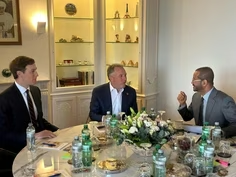
GEOFF BENNETT: We start with Iran and a U.S.# official who told Reuters that progress was made## in roughly three hours of indirect talks# over limiting Tehran's nuclear program.
U.S.
special envoy Steve Witkoff and President# Trump's son-in-law Jared Kushner laid out their## case today with mediators from Oman.
Speaking# to reporters following the talks, Iran's## foreign minister said a new window has opened for# reaching an agreement, though more work is needed.
ABBAS ARAGHCHI, Iranian Foreign Minister (through# translator): We have a clearer picture of what## needs to be done and what needs to be done# down the road.
Of course, both sides still## have positions that need to be brought closer# together, but at least now we have a set of## guiding principles and a clearer path to follow.
GEOFF BENNETT:## Meantime, Iranian officials temporarily# closed the Strait of Hormuz for live-fire## military exercises broadcast# on Iranian state television.## The strait is responsible for the transit# of around 20 percent of the world's oil.
It comes as the Pentagon has added# more naval firepower to the Middle## East in recent weeks with another# aircraft carrier, the USS Gerald Ford,## still en route.
Back in Geneva, U.S.# negotiators Witkoff and Kushner also## brokered the first of two days of talks# with officials from Ukraine and Russia.
Russian state media described the talks# as tense.And Ukraine's delegation has## said they approached the meeting without# excessive expectations as the four-year## anniversary of Russia's invasion looms next week.
A federal judge has ordered# the Trump administration to## restore a slavery-related exhibit at George# Washington's former home in Philadelphia.
MAN: I have great news.
We# just won in federal court.
(CHEERING) GEOFF BENNETT: Supporters celebrated# the ruling outside the co.. calling it a tremendous victory.
Last month, National Park Service workers# took down displays that describe the local## history of slavery on the site, including the# nine enslaved people Washington kept there.
In her decision, Judge Cynthia Rufe cited author# George Orwell's dystopian novel "1984," arguing## the Trump administration does not have the power# to, in her words, disassemble historical truths.
Repair work is underway to fix a# sewer line on the Potomac River,## even as the political battle is raging over what's# been called one of the largest sewage spills in## U.S.
history.
In a social media post today, Mr.# Trump called on the governors of Maryland and## Virginia and the mayor of Washington, D.C., to# -- quote -- "get to work immediately," adding:## "If they can't do the job, they have to# call me and ask politely to get it fixed."
A day earlier, the president placed blame# directly on Maryland Governor Wes Moore,## who fired back, saying the president has his# facts wrong again.
The busted pipe is under## the jurisdiction of a D.C.-based water# authority and the federal government.## The president has directed# FEMA to assist in the cleanup.
In Georgia, a public school in the city# of Savannah is mourning the death of a## special education teacher, Linda Davis, who# was killed in a car crash that involved a## man fleeing ice agents.
The Department of# Homeland Security says Guatemala native## Oscar Vasquez-Lopez tried to evade a traffic stop# early yesterday and collided with Davis' vehicle.
Police charged Lopez with first# degree homicide and reckless driving,## among others.
In a statement, the school's# principal called Davis a beloved member of## its community, saying her contributions to# the students and staff will not be forgotten.
The top spokesperson for the Department of# Homeland Security is stepping down.
The person## familiar with the decision confirms to the "News# Hour" that Tricia McLaughlin will be leaving the## administration next week.
The source says her# departure had been planned since December, but## McLaughlin stayed on following the fatal shootings# of Renee Good and Alex Pretty in Minneapolis.
In her time at DHS, McLaughlin became known as# one of the most vocal defenders of President## Trump's deportation campaign.
Her# exit comes amid growing public## disapproval of the administration's# hard-line immigration policies.
Netflix is granting Warner Bros.
Discovery# a seven day waiver to restart takeover## talks with Paramount.
Warner Bros.
had# already backed a deal for Netflix to## buy its studio and streaming business.# Now Paramount has until Monday to come## up with what they're calling a best# and final offer to upend that deal.
In the meantime, the Warner Bros.
board# is advising shareholders to stick with## the Netflix offer.
Its stock ended# the day more than 2 percent higher.
Elsewhere on Wall Street today, stocks# ended largely unchanged.
The Dow Jones## industrial average gained around# 30 points on the day.
The Nasdaq## added about 30 points.
The S&P# 500 also posted a modest gain.
Several major celebrations and religious# observances are overlapping today.
Let's start## on the streets of New Orleans and Mardi Gras.# Marching bands and floats cruised the streets## of the Big Easy with the traditional tossing# of beads and candy to revelers.
Mardi Gras is,## of course, French for Fat Tuesday, the last# day before Christians begin the season of Lent.
In Egypt, shoppers stocked up on treats and# decorations as Muslims prepare to enter the## holy month of Ramadan.
Those observing the# traditional fast will abstain from eating,## drinking and other activities# during daylight hours.
And, in Beijing, traditional lion dancers# marked the lunar new year holiday and the## start of the year of the horse.
Millions# will be traveling to visit family,## exchanging gifts and taking steps to# ensure good luck for the year ahead.
And in Winter Olympic action today, Team# USA made the podium in several big events,## but came up short in others.
A warning, some# spoilers are ahead.
The U.S.
men won silver in## the speed skating team pursuit, while the women's# team barely missed a medal, coming in fourth.
Mac Forehand secured another silver for Team# USA in an epic free ski big air final amid## practically blizzard conditions.# And in the men's two-man bobsled,## it was a fourth place finish for the# U.S., while Germany swept the event,## winning gold, silver and bronze# for their second straight Olympics.
Looking at the total medal count,# the U.S.
remains in third place## with 21 medals behind host nation# Italy and overall leader Norway.
Still to come on the "News Hour": how# the Justice Department is being reshaped## by controversial priorities# and widespread resignations;## Stephen Colbert calls out CBS for blocking# an interview with a Democratic candidate;## and a new book aims to help readers see Toni# Morrison's literary genius with fresh eyes.
AMNA NAWAZ: The U.S.
Food and Drug Administration# announced recently it will not review Moderna's## mRNA flu vaccine despite late-stage# trials showing it was safe and effective.
The rejection of the experimental flu# application, at least for now, has many in## and outside the industry concerned about the Trump# administration's approach to vaccine development## and recommendations.
It's the latest move that# reflects Health Secretary Robert F. Kennedy Jr.
's## criticism of mRNA technology, which was used by# Moderna and Pfizer to combat the coronavirus.
Michael Osterholm is the director of the# Center for Infectious Disease Research## and Policy at the University of# Minnesota, and he joins me now.
Dr.
Osterholm, welcome back to the# "News Hour."
Thanks for being with us.
DR.
MICHAEL OSTERHOLM, Director, University of Minnesota Center for Infectious Disease Research: Thank you very much.
AMNA NAWAZ: So, let's start# with Moderna's flu vaccine.
For those who don't follow this very closely, why# exactly is this decision causing some concern?
DR.
MICHAEL OSTERHOLM: Well, first of# all, let me just say that the work that## was done by Moderna actually was really# well done and should have been reviewed.## It's an important step forward to# have an mRNA vaccine for influenza.
What happened was, despite the vast majority of# the FDA staff supporting it, a single individual,## Dr.
Prasad, basically decided against approving# it coming forward.
And this sent chills up## the spines of all of us in public health and# the vaccine world because it's so arbitrary.
There was absolutely no basis for which to do# this.
And this really leaves other manufacturers## concerned about what might their future directions# be in terms of confusion and recommendations.
AMNA NAWAZ: So, just for context here,## you mentioned there's one FDA official who# overruled career scientist.. the review go forward.
How often# does something like that happen?
DR.
MICHAEL OSTERHOLM: It rarely happens.
And, more importantly, when it does happen,## there's -- the data are presented as to why.# There this -- there was no data presented,## other than to say that they had not tested the# vaccine against the basic best vaccine out there,## which is one that's only licensed# for those 65 years of age and older.
They actually did test up against the vaccine# that the vast majority of Americans in this## country received every year.
So that's just# an artificial reason for not going forward## with this vaccine.
And I think the only# thing it speaks to is the ideology issue.
We're now running the science component of# public health on ideology, not on facts.
AMNA NAWAZ: And so this concern that they# raised, you touched on briefly there.
The## FDA said that it rejected the application# because it considered the trials too## risky for older Americans.
You're saying# those risks are not real or significant.
DR.
MICHAEL OSTERHOLM: Well, first# of all, what could have happened is,## if in fact they didn't have the data for over 65,# they could surely license it for those under 65,## because that's the standard vaccine# that we are getting in this country. '
And so, from that standpoint, that didn't# make any sense.
They also did do testing to## look at how well their vaccine worked in terms# of providing immune response and found that it## was superior to the high-dose vaccine.
So there# just really was no basis for this.
There was## no prior warning that they were going to apply# this new standard that they did to this vaccine.
And this is what's sending chills up# and down the spines of all of us in## public health.
We don't know how we're# going to get new vaccines in the future,## when they're so arbitrarily# decided upon by the agency.
AMNA NAWAZ: You have said that twice# now.
It's a powerful statement that## it sent chills up and down the spines# of those in public health.
What are## you hearing from those in the# world of developing vaccines?
DR.
MICHAEL OSTERHOLM: Right now, we're# seeing on a global basis a retrenchment## in vaccine research and development, because# the United States is in fact the 800-pound## gorilla in the corner that really drives how# vaccines are purchased, how they're used.
And if in fact you have the U.S.# government saying, we're not even## going to review this particular process,# why does anybody else want to invest in## these?
These studies that Moderna did# cost millions and millions of dollars## to do.
And so we're going to just see, I# think, the well dry up on new vaccines.
And that's a huge challenge right now as we# surely need vaccines for our old flu vaccines,## for COVID, et cetera.
So, again,# it just makes no sense whatsoever.
AMNA NAWAZ: Can I ask you about what# we have already seen with childhood## vaccine recommendations,# which we covered recently?
Last month, the U.S.
took the unprecedented step# of reducing the number of vaccines recommended## for every child from 17 to 11.
They're basically# emphasizing individual doctor-patient decisions,## rather than making universal recommendations.
We're in new territory here, but what could be# the impact of this, both short term and long term?
DR.
MICHAEL OSTERHOLM: Well, the# impact has already been felt.
And that is the fact that parents, often# in their 20s, with their young children,## wanting to do best for their child,# is now hearing about this discussion## or debate or recommendation that# maybe we hold back on vaccines.
Well, when you're a physician, a# nurse practitioner or pharmacist## trying to administer these vaccines, you# have to try to explain, well, no, really,## they still are just as recommended.
But they're# really not because the government says they're## not.
This kind of confusion just adds to# the decreased uptake of these vaccines.
And, in fact, again, the FDA's position on# these vaccines and what came through the ACIP,## the Advisory Committee on Immunization# Practices, is not based on good science.## There's no science to support any of their# recommendations.
They just came out and## declared that these vaccines would now no# longer be standard recommended vaccines.
So, this is dangerous.
And to suggest# we're getting too many vaccines, actually,## they compared us to Denmark, a country# where it's the lowest level of vaccines## per country around the world, including# a number of low-income countries.
We were## right in the middle of the number# of vaccine doses a child received.
And there is no scientific basis# on top of that to say that these## doses are a problem, so, again, smoke and mirrors,## sending up a smoke signal of that we will make# a decision based on ideology, not on science.
AMNA NAWAZ: We now have this Moderna flu vaccine# review rejected.
You have got this change to the## childhood vaccination recommendations.
How would# you say all of this fits into the broader pattern,## both in rhetoric and policy, of what we# have seen from the Trump administration?
DR.
MICHAEL OSTERHOLM: Well, let me just put# it in very simple terms for every parent,## grandparent today.
Children are going# to die in this country needlessly,## more and more are going to die# because of what's happening here.
These are not harmless policies.
These# are dangerous policies.
And we can't## say that strongly enough.
And so I hope# parents hear that message, that, in fact,## do listen to your physician, listen to your nurse# practitioner, listen to your pharmacist.
Don't## listen to the federal government, because they# are not basing their recommendation on science.
AMNA NAWAZ: That is Dr.
Michael Osterholm,## the Center for Infectious Disease Research# and Policy at the University of Minnesota.
Dr.
Osterholm, thank you.
Good to see you.
DR.
MICHAEL OSTERHOLM: Thank you.# Good to see you.
Thank you very much.
GEOFF BENNETT:## Russia launched nearly 400 drones and 29 missiles# at Ukraine overnight.
The full-scale invasion and## war will enter its fifth year next week.# Russia has repeatedly targeted Ukraine's## energy infrastructure, leaving millions there# without heat or electricity for weeks at a time.
Producer and videographer Amanda Bailly# in Kyiv and Nick Schifrin report now## on residents of Ukraine's capital# under fire in record-setting coal.
NICK SCHIFRIN: In Kyiv, this# is a dark, bitter winter,## a once-bustling European capital.
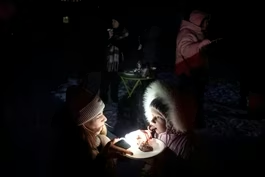
Now the# night streets lie mostly desolate and cold,## a city whose homes look as Russia wants# them, empty, its residents living in shadows;## 73-year-old Lyudmila Bachurina cooks in her 19th# floor apartment by flashlight and gas burner.
This winter, the temperatures dropped# to minus-14 degrees Fahrenheit.
The## windows are lined with ice.
She helps her# daughter stay warm.
The power plants here## provide both light and heat.
They have# had neither for up to 17 hours a day.
LYUDMILA BACHURINA, Kyiv Resident (through# translator): I'm tired.
It's really tiring,## to be honest, when you don't go# outside and you don't see the sun,## when there's no light and you# can't just go down to the store.
OLENA JANCHUCK, Kyiv Resident: When# my husband is at work, my mother and## I are dealing with all this together.# My mother and I, we support each other.
NICK SCHIFRIN: There is no limit to the support# that 63-year-old Vasyl Ivanovych will give to## his 40-year-old son, Taras (ph).
But# in blackouts, the burden is heavier.
Taras is disabled and can't walk.
And# no electricity means no elevator.
Vasyl## says he feels like the war has set them back# hundreds of years.
Inside, no power or heat,## so the warmth comes from Vasyl caring for his# son and from the orthodox Christmas trimmings.
But this family is especially vulnerable.# The closest shelter is two blocks away.## And sometimes the missiles land without# warning.
Since the start of the year,## Ukraine says Russia has attacked the energy# grid more than 217 times, including at## least six strikes that damaged all three of# Kyiv's major combined heat and power plants.
It's not all the time.
Vasyl Ivanovych invited# us back when the family had power.
He used to## work at the local subway station.
Now# he is his son's full-time caregiver.## He keeps a car battery in# the kitchen for charging.
VASYL IVANOVYCH, Kyiv Resident# (through translator): When people## are left without g.. especially children, pensioners, the# elderly and people with disabilities.
NICK SCHIFRIN: He shows himself# in younger days and his family,## his grandfather wearing a Soviet uniform.# Today, he calls Russians terrorists.
VASYL IVANOVYCH (through translator): I# can't imagine these children will grow## up and remember these times, Russia and# these people who did all this.
And I'm## not even talking about those who have# seen someone die with their own eyes.
NICK SCHIFRIN: And yet Ivanovych# maintains his humor and appetite,## even if he knows the power is not reliable.# He starts comparing today to Soviet times.
VASYL IVANOVYCH (through translator): Who# knows what's better at the end?
Oh, the## power just went out.
The elevator isn't# working.
There's no light.
But that's OK.
DONALD TRUMP, President of the# United States: Because of the cold,## extreme cold.
They have the same that we do.
NICK SCHIFRIN: Last month at a Cabinet meeting,## President Trump announced a deal# with Russia to spare Ukrainian power.
DONALD TRUMP: I personally asked President Putin## not to fire on Kyiv and the# cities and towns for a week.
NICK SCHIFRIN: That was Thursday, January# 29.
Three days later, on February 1,## a Russian drone hit a bus in Southeast# Ukraine.
The strike killed 12 coal miners,## considered members of Ukraine's energy# sector.
And then, two days later,## February 3, Russia's largest strike on Kyiv# so far this year damaged two power plants.
VOLODYMYR ZELENSKYY, Ukrainian President (through# translator): They want to take advantage of the## cold because they cannot subjugate us with their# assaults.
Every Russian st.. energy sector, but also those leaders who talk# to Russia and receive continued war in response.
NICK SCHIFRIN: That continued# war has forced millions in Kyiv## to fend for themselves in subzero# temperatures, often for weeks at## a time.
But Ukrainians are resilient and# sometimes turn the cold into celebration.
(MUSIC) NICK SCHIFRIN: A deejay led a rave on Kyiv's# frozen Dnipro River, dancing for de.. because, just hours before, Russia had launched# 375 drones and 21 missiles at Kyiv and Kharkiv,## leaving 1.2 million Ukrainians without power.
The strikes and blackouts are so common, Kyiv# created invincibility points, fitted with heat,## power, water and food, a tent where Kyiv# residents can find brief distraction## from the war; 79-year-old Vyacheslav# Piontovsky and his 78-year-old wife,## Kateryna, live on the 12th floor# of a nearby apartment building.
They have come for some much-needed heat and# to recharge their phones and their resolve.
KATERYNA PIONTOVSKYA, Kyiv Resident# (through translator): We stand strong## because we want victory.
Nothing will break us,## not the cold or hunger.
We're ready to# survive anything.
We're not giving up.
NICK SCHIFRIN: But the relentless attacks are too# much to bear for others like Natalia Shponarska.
NATALIA SHPONARSKA, Kyiv Resident# (through translator): Emotionally,## it's the fifth year.
We can't keep coping.# I'm .. NICK SCHIFRIN: It is hard for her 8-year-old son,## Mark, to watch his mother cry.
But in this# tent with 10-year-old Nastya (ph), at least## the family can stay warm.
They# haven't had heat for three days.
NATALIA SHPONARSKA (through translator):# At home, there is no power, no water,## no heating.
We live on the 16th floor.# It's so cynical what that jerk Putin## says about wanting peace with Ukraine.# He kills every day.
This is his peace?
NICK SCHIFRIN: This is not peace.
This is# war.
And war can be cold, dark and relentless.
For the "PBS News Hour," with Amanda# Bailly in Kyiv, I'm Nick Schifrin.
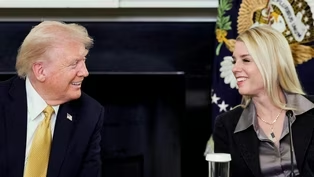
AMNA NAWAZ: Shortly after she was confirmed,# Attorney General Pam Bondi told lawyers at the## Department of Justice that it was their# job to -- quote -- "zealously advance,## protect and defend the policies of the# United States as set by the president."
It was an early example of the ways in# which the Trump administration has sought## to transform the DOJ into the president's tool for# promoting his agenda and challenging detractors.
Justice correspondent Ali Rogin and the "News# Hour" politics team have been reviewing the## events of the past year to better understand# how this transformation is playing out.
And Ali joins me now.
So, Ali, we know a big part of this story is the## number of attorneys who've left# the DOJ.
What have you found?
ALI ROGIN: Yes, Amna, since last January, the DOJ# work force has fallen by about 8 percent, which## represents about 9,000 employees.
About a# fifth of that were people who accepted the## DOGE offer at the beginning of the# administration to retire or leave.
But if you look at this chart of total# DOJ staffing changes by fiscal year,## they're usually not that drastic.# They increase a little one year,## they decrease a little the next year.
But then,# in fiscal year 2025, there is a significant drop.
AMNA NAWAZ: So what should we understand# about that?
Why are people leaving?
ALI ROGIN: Yes, I have spoken to a number of# attorneys who have served in both Democratic## and Republican administrations, many of them# including the first Trump administration.
And they say that it is normal for policy# priorities in the Department of Justice to## change, depending on who's in office,# what party.
That's even what was done## in the first Trump administration.
But# they say this time is very different,## and Attorney General Bondi seems to be taking# directions directly from President Trump.
These attorneys have many different reasons# for leaving.
Some of them were motivated by## the dismissal of some prosecutors who worked on# January 6 cases.
Others left after the prosecution## of Kilmar Abrego Garcia, after he was wrongly# deported.
Some lawyers have quit in response to## the DOJ's hands-off approach to the immigration# actions we're seeing across the country.
In Minnesota, a group of attorneys# quit after the DOJ declined to## prosecute the ICE agent who shot# and killed Renee Good.
And also,## Amna, we have seen the DOJ decimate or# completely eliminate entire offices.
AMNA NAWAZ: What does all this# mean for the work of the DOJ,## their ability to investigate and prosecute cases?
ALI ROGIN: Well, one of the things it means# is that attorneys are stretched thinner and## people are prosecuting cases on which they# have little to no subject matter expertise.
In fact, in Minnesota, one of the prosecutors# who resigned was actually leading many of the## social services fraud cases that had# initially drawn the attention of the## Trump administration to this# state.
Another benchmark I'm## tracking is the failures to return# indictments before grand juries.
The bars for returning indictments# is relatively low.
They have to find## probable cause that an offense took place.# And it doesn't need to be unanimous.
Amna,## there's an old saying here that you could# indict a ham sandwich.
And that's why,## in recent years, the DOJ has# pursued more than 100,000 cases.
And in most years that we have data for,# they have only failed to get a no true bill,## which is what failure to indict is# known as, in a handful of cases.
But in this DOJ, one official told me, former# official, said there was a shockingly high## number of no true bills, notable cases, include# two failed attempts to indict New York Attorney## General Letitia James, the case against the# so-called sandwich guy involving a man who## threw a sandwich at a federal agent, and more# recently, last week, six lawmakers who taped a## video saying that service members did not have# to obey illegal orders from the president.
AMNA NAWAZ: What are we hearing,# meanwhile, and seeing from the## leaders inside DOJ?
We have seen allegations# of retribution.
Are we seeing that action?
ALI ROGIN: We're hearing some of it.
In November, Deputy Attorney General# Todd Blanc.. against judges.
And the Justice Department# is also trying reportedly to impeach judges## that they consider obstructive.
And for# context, since 1803, there have been 15## impeachments of judges, and eight of them# have resulted in conviction and removal.
The DOJ has also taken the unusual step# of overriding some judges' choices for## people to serve as U.S.
attorney# if no one's been Senate-confirmed## to those positions.
This happened# in New Jersey, where judges picked## a prosecutor.
The DOJ overruled them and# installed Trump's personal lawyer, Alina Habba.
Or, recently, it happened in New York, where# judges appointed a veteran prosecutor.
And## then a few hours later, Todd Blanche# tweeted that the man had been fired.
And, Amna, we reached out to the# Department of Justice with a list## of questions about all of this.
They have not# yet responded, but we will update if they do.
AMNA NAWAZ: All right, that's our# justice correspondent, Ali Rogin.
Ali, thank you.
ALI ROGIN: You bet.
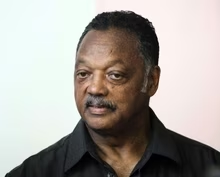
GEOFF BENNETT: The Reverend Jesse Jackson,## the civil rights leader and two-time# presidential candidate, died peacefully## this morning at the age of 84.
He's being# remembered for his decades of activism.
His family wrote, in part: "Our father was# a servant leader, not only to our family,## but to the oppressed, the voiceless,# and the overlooked around the world."
From the civil rights movement of the 1960s,## to protesting police brutality# some six decades later... REV.
JESSE JACKSON, FOUNDER, Rainbow/PUSH# Coalition: We're all precious in God's sight.
GEOFF BENNETT: ... Jesse Jackson was one of the# nation's most prominent civil rights.. a political pioneer.
His historymaking bids for# the White House in the 1980s sparked a movement.
REV.
JESSE JACKSON: I see the face# of America, red, yellow, brown,## Black, and white.
We're all precious in# God's sight, the real rainbow coalition.
GEOFF BENNETT: Jesse Jackson was born# and raised in Greenville, South Carolina,## where he attended racially segregated# schools.
His first major protest was in 1960,## where he was one of eight students to organize# a sit-in at the local whites-only library.
While attending North Carolina A&T, a historically# Black institution, he continued to participate## in protests against segregated businesses.
After# graduating, he moved to Chicago to attend Chicago## Theological Seminary.
He eventually dropped# out to focus on the civil rights movement.
During this time, he met and worked# with the Reverend Dr.
Martin Luther## King Jr.
Jackson was one of hundreds# who marched from Selma to Montgomery,## and soon after began organizing in Chicago for# the Southern Christian Leadership Conference.## Jackson grew close to Dr.
King and soon# became a member of his inner circle.
On the night of Dr.
King's assassination,# Jackson was in Memphis with him and## witnessed the shooting.
The moment# would shape the rest of his career.
REV.
JESSE JACKSON: He dreamed not just of# the privatized notion of content of character,## rather than color of skin.
He# dreamed of the public policy## notion of once we change the law.
He# used his faith to challenge the law.
GEOFF BENNETT: After Dr.
King's death,# Jackson was involved in multiple debates## and disputes over how to approach the# future of the civil rights movement.
REV.
JESSE JACKSON: We're going# to be shot in the back anyhow!
GEOFF BENNETT: He eventually left the SCLC to# launch his own organization, Operation PUSH,## dedicated to improving economic conditions# in Black communities across the country.
REV.
JESSE JACKSON: We are displeased.
We# do not like it.
Cut us in or cut it out.
GEOFF BENNETT: The group received national# attention for pressuring major corporations## to hire more African Americans,# sometimes by threatening boycotts.
REV.
JESSE JACKSON: I'm# simply challenging the party.
GEOFF BENNETT: Jackson decided to step away from# the group in the early 1980s to influence policy## in a different way, running to lead the country.# In 1983, he announced his first campaign for the## White House.
His campaign, he said, was# not solely about winning the nomination,## but about fighting for the rights of a diverse# so-called rainbow coalition of Americans.
REV.
JESSE JACKSON: America is# more like a quilt, many patches,## many pieces, many colors, many sizes, all# woven and held together by a common thread.
GEOFF BENNETT: While detractors# wrote him off as a fringe candidate,## he finished in third place in the Democratic# primaries.
He announced a second bid for the## White House in 1988 and found more# success.
Jackson won primaries and## caucuses in 11 states and refused to# exit the race until the convention.
He ultimately finished second in# the race.
It was the first time## a Black candidate was widely viewed as# a viable contender for the presidency.
Former "PBS News Hour" co-anchor the late Gwen# Ifill covered him for The Washington Post.
GWEN IFILL, Former "PBS News Hour" Anchor:# The most disorganized, exhilarating,## inventive campaign ever, because he would# just show up places and could attract crowds.
GEOFF BENNETT: Jackson remained a# prominent presence in American politics,## serving as one of Washington, D.C.
's first# shadow senators, a position that primarily## advocated for D.C.
statehood.
He also# frequently met with foreign leaders.
He negotiated the release of dozens# of hostages during wars and conflicts,## often without approval from presidents# or Congress.
In 2007, when fellow Chicago## Democrat Barack Obama announced a bid# for the White House, Jackson endorsed## him.
Their relationship grew complicated# at times over the course of the campaign.
But at Obama's victory rally, Jackson was in tears# over the historic election of the country's first## Black president.
Jesse Jackson's family followed# in his political footsteps.
One of his sons,## Jesse Jackson Jr., represented Illinois in# Congress for more than 15 years, before stepping## down in 2012 after being accused and eventually# convicted of defrauding campaign donors.
Another son, Jonathan Jackson, now# represents Illinois in Congress.
Jackson## had several health concerns in recent# years.
He was hospitalized in November## to treat the neurodegenerative condition# called progressive supranuclear palsy,## or PSP, initially diagnosed as# Parkinson's disease in 2017.
But despite the health setbacks, Jesse# Jackson continued his advocacy work,## including participating in Black Lives# Matter protests and getting arrested## during demonstrations and sit-ins# in support of social justice issues.
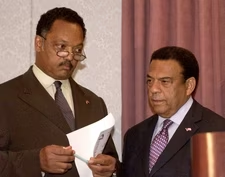
And we turn now to someone who stood# alongside Jesse Jackson during some## of the most consequential chapters# of the modern civil rights movement.## Ambassador Andrew Young is a former# U.S.
ambassador to the United Nations,## former mayor of Atlanta and longtime lieutenant# to the Reverend Dr.
Martin Luther King Jr.
I spoke with him earlier today and asked him about## Reverend Jackson's role in# pushing for civil rights.
ANDREW YOUNG, Former U.S.
Ambassador# to the United Nations: Well, Reverend## Jackson was the second or third .. in a way, he follows best under the generation of# students coming out of the '60s and the sit-ins.
And he was a member of the group in North# Carolina A&T, Agriculture and Technical College,## that started the sit-ins.
This was five# years after Martin Luther King started the## Montgomery bus boycott.
It was this background## and the fact that he grew up in the Negro# church that prepared him for leadership.
His preaching and speaking was very much like that# of Martin Luther King, so much so that he often,## in the early days, tried to imitate Martin Luther# King.
As he matured in the movement, he developed## his own style of speaking, which was a combination# of the Black church and the movement of students.
GEOFF BENNETT: Well, let me ask you# more about that, because his 1984 and## 1988 campaigns reshaped politics, reshaped the# Democratic Party, reshaped coalition politics.
What did his voice as a preacher allow him to do,## allow him to say that a# traditional politician could not?
ANDREW YOUNG: Well, it was not so much that# it allowed him to say anything different.## He was basically saying the same thing that# Martin Luther King and his father were saying## years before, and even Martin's grandfather.
But Jesse mixed it with the modern jazz# of the '60s and the kind of a hip-hop## of sort of give-and-take speech, as though# you're preaching to yourself.
You ask a## question and then you give the answer.# But he was a very effective speaker,## partially because he had a great voice, and# he was he was really a good-looking kid.
He spoke the language of the young# people, which was more rhythmic## and give-and-take.
And he was funny.
He# could turn a phrase.
And "I am somebody"## became an effort of asserting his identity in# a society that did not really recognize him.
GEOFF BENNETT: When history# writes about Jesse Jackson,## what do you hope it understands about his place# in the long arc of the civil rights movement?
ANDREW YOUNG: Well, I think that he# certainly deserves an important place,## if not for his runs for presidency, for his# ability to mobilize large numbers of people.
He was a great speaker before a crowd.
And he# was always able to gather a crowd.
In fact,## every Saturday morning, he rallied the churches# of Chicago, first in Operation Breadbaskets## and then Operation PUSH, which were efforts# on his part to get the economy of Black## America integrated into the economy of, in this# case, the supermarkets and department stores.
And he was something of an economic prophet# before he started his run for the presidency.
GEOFF BENNETT: Ambassador Andrew# Young, thank you for your time,## sir, and my condolences on# the loss of your friend.
ANDREW YOUNG: Thank you.
AMNA NAWAZ: Late-night show host Stephen Colbert# is going after his soon-to-be-former network,## saying CBS blocked him from airing# an interview on the broadcast.
That## interview was with James Talarico,# a Texas Democrat running for Senate## who's also been a vocal critic of# President Trump and his policies.
Colbert said he was told the interview could# violate the so-called equal time rule, which## mandates that all political candidates receive# equal on-air opportunities.
Entertainment shows,## including late-night and daytime talk shows,# have long been the exception to that rule.
But, back in January, FCC Chairman Brendan Carr# released a letter saying that could change.
Here's Colbert from last night.
STEPHEN COLBERT, Host, "The Late Show# With Stephen Colbert": In this letter,## Carr said he was thinking about# dropping the exception for .. shows because he said some of them# were motivated by partisan purposes.
Well, sir, you're chairman of the# FCC, so FCCU, because I think... (CHEERING) STEPHEN COLBERT: Because I think you are# motivated by partisan purposes yourself.
(CHEERING) STEPHEN COLBERT: Sir, you# smelt it because you dealt it.
(LAUGHTER) AMNA NAWAZ: For more, I'm joined# now by FCC C.. Welcome back to the "News# Hour."
Thanks for being here.
ANNA GOMEZ, Commissioner, Federal Communications# Commission: Thank you.
It's good to be .. AMNA NAWAZ: I should also note we did invite# FCC .. but his office did not respond.
He's# welcome to join us in the future.
I want to put to you some confusing# narratives we have here.
Colbert,## we have heard, is saying he was# told by CBS lawyers Talarico could## not be on the broadcast.
So he ran the# interview on YouTube instead.
But CBS## in a statement today said that Colbert was# not prohibited from airing the interview.
He was told it could trigger the FCC# equal time rule and that he chose to## stream it on YouTube instead.
What# do you make of these two narratives?
ANNA GOMEZ: Well, I don't know between# the two facts that are being provided,## but I do know that what the FCC did this year was,## it put out a notice about the equal time rule# that doesn't really give us anything new.
The equal time rule has been on the books for# a very long time.
It's a part of the statute.## And what it does is, it allows# legally qualified candidates to## request equal time if a show puts on# another legally qualified candidate.
AMNA NAWAZ: OK.
ANNA GOMEZ: But ther.. something that basically says, if you are# providing programming that is newsworthy,## then you are exempt from# this equal time requirement.
The FCC has longstanding practice of declaring# news -- entertainment programs to be newsworthy,## for example, "The Tonight Show," Sally Jessy# Raphael, "Politically Incorrect," "Donahue."
Those## were all found to be bona fide news exemptions# because of the newsworthiness of their programs.
AMNA NAWAZ: So is that a rule that the FCC# chairman could change?
Could that equal time## rule now be expanded to include daytime and# late-night shows that were previously exempt?
ANNA GOMEZ: Well, what the FCC did was# it put out a public notice that said,## hey, just because we have this precedent# doesn't mean that everything that you are## doing is actually subject to this# news exemption.
And we want to now## review everything that you're doing# in order to make that determination.
One of the things that's really important to# note is that in declaring whether something is## subject to the bona fide news exemption,# what it does is, it says -- has the producer,## the independent producer or the broadcaster,# made a decision that is reasonable about the## newsworthiness of that particular programming, as# opposed to having the candidate, the programming,## the format, the content being done for purposes# of harming or helping a particular candidate?
The FCC relies on the reasonable good# faith judgment of the broadcasters in## making that determination.
So the point# that I'm trying to make here is that this## public notice that the commission# put out is not anything new.
It## is saying we have this equal time rule# and we want people to be aware of that.
AMNA NAWAZ: Yes.
And yet at the same time## it's now triggered this episode# that we're all talking about.
I mean, you did accuse CBS of corporate# capitulation to administration efforts to## censor and control speech.
And Texas State# Rep.
James Talarico in that interview that## aired on YouTube said sort of the same# thing.
And take a listen to how he put it.
STATE REP.
JAMES TALARICO (D-TX): Corporate# media executives are selling out the First## Amendment to curry favor with corrupt# politicians.
And a threat to any of## our First Amendment rights is a threat# to all of our First Amendment rights.
(CHEERING) AMNA NAWAZ: There are those who are going# to say the interview was published, right?## We are airing it.
Others are airing it.
People# are talking about it.
Why censorship concerns?
ANNA GOMEZ: The concern here is because this# is a part of a broader pattern by this FCC## and this administration to get our corporate# parents of our broadcasters to capitulate and## to modify how they are reporting the news, to# do so in a way that this administration likes.
Anything they don't like, they want to control# and they want to censor.
So, in this case,## it's just part of a broader pattern.
Now,# maybe it's true that the facts between CBS## and the Colbert show are different, but the# fact that we're in this moment and talking## about this tells you that we are in a very# precarious moment for our First Amendment.
And the FCC needs to stay# out of content regulation## because our First Amendment prohibits it.
AMNA NAWAZ: So what is the# impact of that pattern as## you lay it out?
How could it change programming,## especially when we're talking about a year in# which there are midterm elections coming up?
ANNA GOMEZ: Broadcasters are already# self-censoring because they don't## want to get before the crosshairs of# this administration.
And that is bad## for the First Amendment.
It's bad for the# freedom of the press.
We need broadcasters,## we need all journalists to hold us to account,# because that is their role in our democracy.
So this is very serious.
AMNA NAWAZ: That is FCC Commissioner# Anna Gomez joining us tonight.
Commissioner Gomez, thank you for# your time.
Really appreciate it.
ANNA GOMEZ: Thank you.
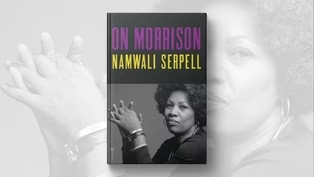
GEOFF BENNETT:## In her new book, award-winning# novelist Namwali Serpell takes## on one of the towering figures in# American literature, Toni Morrison.
Serpell guides readers through# Morrison's extraordinary body of work,## from her celebrated novels, to# her criticism, poetry and plays,## offering close readings that illuminate# the depth of Morrison's imagination,## innovation and craft.
And it asks what it means# to read Morrison with fresh eyes in our time.
I recently spoke with Namwali# Serpell about her book "On Morrison."
Namwali Serpell, thank you for being here.
NAMWALI SERPELL, Author, "On Morrison":# Thank you so much for having me.
GEOFF BENNETT: In this book, you focus# on the entiret.. the 11 novels, the play, beyond.
And early in the book, you write: "I# never met Morrison.
I never tried to## either.
I have loved knowing her through# reading her over the decades of my life."
Why was it important to establish that distance# at the beginning to make clear that the work,## not the woman, was the primary focus?
NAMWALI SERPELL: Thank you# so much for that question.
Morrison herself had a version to what she# called biographical writing.
She thought## that human beings had a kind of copyright on# their selves.
And so she said, for her, writing## was very much about invention, imagining someone# from the curl to the full human being, she said.
She often advised her creative writing# students, I don't want to hear about your## little selves.
Don't write about yourself.# I want you to write about other people.
And when she contracted to write a memoir,# she ended up canceling that project,## because she said, my life's not that interesting.
So I sort of feel like I have the privilege# of getting to know Morrison through her work,## in a way, because she gives us that# permission.
Reading and writing were## also so foundational to what she believed and# to how she herself related to other people.## She said, writing for me is a# slow and advanced form of reading.
And so, in that sense, I felt that kind of# literary relationship was something that I really## wanted to unfold in my analysis of her work.# Rather than thinking about her as this kind of## monument to Black excellence, I wanted to# really dig in and play with her language.
GEOFF BENNETT: And her work is so often# understood to be and described as difficult,## sometimes as a criticism, sometimes as a warning.
And in the book, you argue that# the difficulty isn't a flaw;## it's really a demand placed on the# reader.
Tell me more about that.
NAMWALI SERPELL: Morrison was very good# at articulating why she did the things## that she did in terms of her choices, her# formal choices, the choices of design.
And she spoke about, for example, having gaps# and spaces in the work so that the reader has## to step in to piece things together.
And,# for her, this was part of an ethos that## had to do with egalitarianism, treating the# reading experience, the writing experience,## the whole literary experience as a kind of# communal, mutually enforcing engagement.
You have to actually work to make the work come to# life with her.
And I think, for her, that was very## important, very much a part of a Black aesthetic.# When you're in a jazz show, the hoots and hollers## and the calls and the clapping is as much part# of the performance as the playing of the music.
GEOFF BENNETT: A question just occurred# to me.
How can a writer like Toni Morrison## be fully institutionalized, in the# sense that she is taught everywhere,## and yet fundamentally misunderstood# and not read on her own terms?
NAMWALI SERPELL: This is a# really, really key question.
And it's a paradox that her very good friend# Fran Lebowitz articulated when Morrison passed## away.
She said Morrison's writing was# underappreciated, curiously enough,## perhaps because people always looked at it# through the prism of her being Black and her## being a woman.
There's a way in which her stature,# her success came to overshadow the work itself.
There's a kind of presumption# that Morrison's work is brilliant,## it's beautiful, but people don't# actually need to read it.
And,## in this way, there's been a lack of attention# to how experimental her writing was and how## innovative her writing was, how much# she broke the form of the novel open.
I also think, for a long time, there were# not readers able to bridge, as she did,## her understanding of the novel with her# understanding of Black cultural forms,## things like signifying, things# like shade, things like jazz.
And it's by having this kind of balance of the# two forms of knowledge, as a professor myself,## as a Black woman, as a writer, that# I feel like I wanted to contribute to## the conversation about Morrison's work,# focusing on her mastery of Black form.
GEOFF BENNETT: It's interesting.
I hear you# say that the paradox of Toni Morrison was that,## the more she was celebrated, the# less rigorously she was read.
NAMWALI SERPELL: She was read, yes.
GEOFF BENNETT: And in this moment# that prizes clarity and accessibility## and instant comprehension, what added# value does Toni Morrison's work yield?
NAMWALI SERPELL: I think Morrison wanted to go# back to what she described as village literature,## which is a notion that literature is# a social form, it's a community form,## and therefore it can't just tell you,# the individual reader, what to do.
It has to open up questions so that we can# talk about it as a community.
We're not just## being given a message or a single slogan.# We're being given an experience.
And that## experience is raising questions, is opening# up all sorts of topics for debate so that,## when you close the cover of the# novel and you turn to the final page,## you immediately want to seek someone# out and talk to them about it.
That, to me, is the power of literature.
GEOFF BENNETT: You end the book by saying# that you aspire to Morrison's freedom to## be at ease with being difficult.
What does that# freedom look like, especially for Black women?
NAMWALI SERPELL: It's a very tricky time to# be willful, to be unreasonable, to be angry.
These are all ways in which Black women get# relegated to the category of being difficult.## But I think we have to have a faith and a# commitment to the complexity of our experience,## to the complexity of our lives, and to# the incredible complexity of art itself.
Morrison said, when someone considers you# difficult, that's a good sign.
It means that## you have insisted on being taken seriously.
And,# to me, that's what I aspire to.
I want my work## to be taken seriously.
I want to be taken# seriously.
I don't want to be thrown into## a position where I'm here nearly to comfort,# or placate, or translate things for people.
I want to inspire them.
I want to engage# with them, and I want to make them think.
GEOFF BENNETT: The book is extraordinary.
NAMWALI SERPELL: Thank you so much.
GEOFF BENNETT: "On Morrison."
Namwali Serpell, thank you for being he.. NAMWALI SERPELL: Thank you.
AMNA NAWAZ: And that is the "News Hour"#for tonight.
I'm Amna Nawaz.
GEOFF BENNETT: And I'm Geoff Bennett.
For all of us here at the "News Hour," thank..
 New
NewAndrew Young reflects on partnership with Jesse Jackson
Video has Closed Captions
Clip: 2/17/2026 | 5m 17s | Andrew Young reflects on friendship and partnership with Jesse Jackson (5m 17s)
 New
NewFCC commissioner on 'equal time' after Colbert-CBS dispute
Video has Closed Captions
Clip: 2/17/2026 | 6m 42s | After Colbert says CBS blocked interview, FCC commissioner weighs in on 'equal time' (6m 42s)
 New
NewHow Trump and Bondi have transformed the DOJ
Video has Closed Captions
Clip: 2/17/2026 | 5m 4s | How Trump and Bondi transformed the DOJ to push his agenda and challenge detractors (5m 4s)
 New
NewA look at Jesse Jackson's decades of civil rights advocacy
Video has Closed Captions
Clip: 2/17/2026 | 5m 46s | A look at Jesse Jackson's decades of civil rights advocacy (5m 46s)
 New
NewNamwali Serpell celebrates literary genius in 'On Morrison'
Video has Closed Captions
Clip: 2/17/2026 | 7m 44s | Namwali Serpell celebrates Toni Morrison's literary genius in 'On Morrison' (7m 44s)
 New
NewNews Wrap: U.S. says progress made in Iran nuclear talks
Video has Closed Captions
Clip: 2/17/2026 | 7m 9s | News Wrap: U.S. says progress made in indirect talks on Iran's nuclear program (7m 9s)
 New
NewUkrainians face winter without heat after Russian attacks
Video has Closed Captions
Clip: 2/17/2026 | 6m 59s | Ukrainians face brutal cold without heat after Russian attacks on energy grid (6m 59s)
 New
NewU.S. blocking new mRNA flu shot 'sends chills,' expert warns
Video has Closed Captions
Clip: 2/17/2026 | 6m 59s | U.S. rejection of new mRNA flu vaccine 'sends chills,' epidemiologist says (6m 59s)
Providing Support for PBS.org
Learn Moreabout PBS online sponsorship
- News and Public Affairs

FRONTLINE is investigative journalism that questions, explains and changes our world.

- News and Public Affairs

Amanpour and Company features conversations with leaders and decision makers.











Support for PBS provided by:
Major corporate funding for the PBS News Hour is provided by BDO, BNSF, Consumer Cellular, American Cruise Lines, and Raymond James. Funding for the PBS NewsHour Weekend is provided by...