
September 4, 2026
9/4/2026 | 55m 43sVideo has Closed Captions
Kai Bird; Tanaz Eshaghian; Wilbert Cooper
Kai Bird discusses his new biography of notorious lawyer and Trump mentor, Roy Cohn. Tanaz Eshaghian's new documentary, "An Eye for an Eye," shines a light on the oppressive and misogynistic laws in Iran and one woman's fight for her life. Wilbert Cooper looks at the tensions between race and duty in his family of Black police officers in his book "The Black Shield"
Problems playing video? | Closed Captioning Feedback
Problems playing video? | Closed Captioning Feedback
September 4, 2026
9/4/2026 | 55m 43sVideo has Closed Captions
Kai Bird discusses his new biography of notorious lawyer and Trump mentor, Roy Cohn. Tanaz Eshaghian's new documentary, "An Eye for an Eye," shines a light on the oppressive and misogynistic laws in Iran and one woman's fight for her life. Wilbert Cooper looks at the tensions between race and duty in his family of Black police officers in his book "The Black Shield"
Problems playing video? | Closed Captioning Feedback
Where to Watch Amanpour and Company
Amanpour and Company is available to stream on pbs.org and the PBS app.
Watch Amanpour and Company on PBS
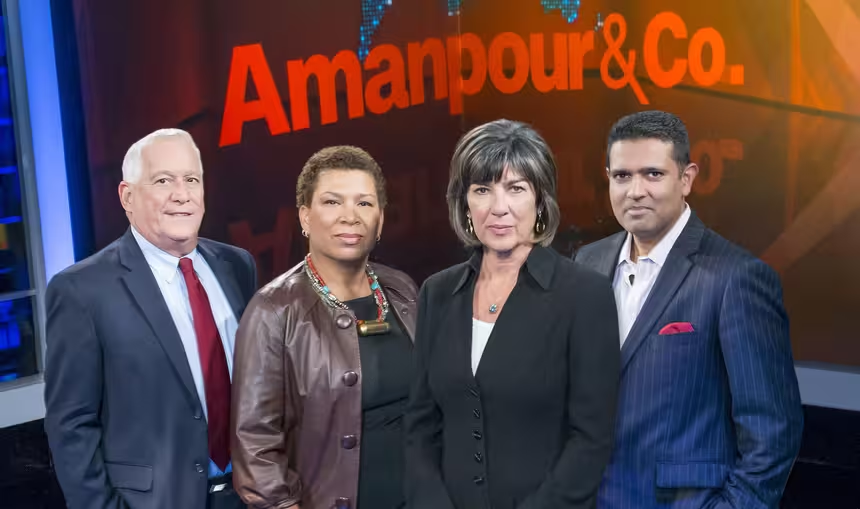
PBS and WNET, in collaboration with CNN, launched Amanpour and Company in September 2018. The series features wide-ranging, in-depth conversations with global thought leaders and cultural influencers on issues impacting the world each day, from politics, business, technology and arts, to science and sports.Providing Support for PBS.org
Learn Moreabout PBS online sponsorshipHello everyone and welcome to Amanpour and Company.
Here's what's coming up.
If you look at the life of Roy Cohn, you suddenly see into the soul of Donald Trump.
As the U.S.
midterms approach and President Trump takes aim at how America votes, a look at the notorious Red Scare lawyer Roy Cohn, who mentored Trump and taught him many of the tactics and tricks he still uses today.
Pulitzer Prize winning author Kai Bird joins me to discuss his new biography of Cohn.
Then, if she can manage to raise the blood money that the victim's family demands, she has a way out.
Director Tanaz Esharian tells me about the making of her new documentary, An Eye for an Eye, and what she learned about the complicated line between justice and vengeance in Iran's Islamic legal system.
Plus... There was often a real disgust and distrust with law enforcement, even though law enforcement was the institution that paid for the safety and the home and things that we had.
Journalist Wilbert Cooper speaks to Michelle Martin about living through paradox as he grew up the son of two black cops in the US Midwest.
Amanpour & Company is made possible by The Anderson Family Endowment, Jim Atwood & Leslie Williams, Candace King Weir, The Sylvia A.
& Simon B. Poita Programming Endowment to Fight Antisemitism, The Strauss Family Foundation, The Peter G. Peterson & Joan Gantz Cooney Fund, Charles Rosenblum, Monique Schoen-Warschau, Kou and Patricia Ewan, Committed to Bridging Cultural Differences in Our Communities, Barbara Hope Zuckerberg, and by contributions to your PBS station from viewers like you.
Thank you.
- Welcome to the program, everyone.
I'm Christiane Amanpour in London.
The U.S.
midterms are just two months away, seen around the whole world as a health check on Trump's record.
Right now, the prognosis is not good.
His polls are dramatically down, hitting new lows just this week.
As he keeps the United States embroiled in a stalemated forever war with Iran, unleashing chaos on global markets and on the home front.
Then there's the latest in the trade war he's launched with Canada, one of America's closest trading partners.
One of Trump's main biographers, Maggie Haberman, says that Trump's superpower is his shamelessness.
So where did he learn the tricks of that trade?
Kai Bird brings us some answers, a Pulitzer Prize-winning author and self-described biographer of the American establishment.
His latest book, "American Scoundrel," looks at the life of Roy Cohn, the notorious lawyer and fixer who mentored Trump and whose fingerprints can still be seen on American politics today.
Kaibird, welcome to our program from our studios in New York.
Let me just give you or give our viewers the subtitle of your book, "Roy Cohn's Dark Journey from Joe McCarthy to Donald Trump."
Well, that is going to prick up everybody's ears.
Explain that.
I mean, it's a big arc and somehow he was there at all the wrong times.
Yes, well, I've been working, living with Roy Cohn for four years now, so I'm very eager to tell the arc of his story.
You know, it's an incredible life, an incredibly important life.
He, of course, was Senator Joe McCarthy's chief counsel, but even before that, he was one of the prosecutors who sent the Rosenbergs, Ethel and Julius Rosenberg, to the electric chair for Atomic Spine.
And then as Joe McCarthy's chief counsel, he sort of was the brain for the senator and his witch hunt against American communists in the early 1950s.
And then the arc goes all the way, you know, back to New York and where he becomes a mob lawyer for all five mob families.
And then in October of 1973, he meets a young real estate developer named Donald Trump.
And they click, and he becomes his lawyer for the next 13 years.
And he really molds Donald Trump into what we see today.
A man who I think is one of the most controversial presidents we've ever had and actually consequential over the last 10 years.
It's an incredible story.
>> It is, but it's also incredible to think that Roy Cohen became so consequential through the causes and the people he served.
At one point, you write, and we sort of remember it reported, that during Trump 1.0, when he was undergoing all sorts of, you know, inquiries from the Justice Department and there was the Russia and there was all this, he said, "Where is my Roy Cohen?"
What did that mean?
Obviously, Roy Cohen, by that time, was long dead.
Yeah, well, Roy Cohen was very important to Donald Trump, to his rise, to how he thinks of himself.
And Roy's image was that of a tough-minded, no-nonsense lawyer who taught Donald Trump how to deal with the press, how to deal with the courts, how to attack, attack, attack when you're attacked, how to never apologize, how to, you know, be brazen in your breaking of the rules.
And this was Roy Cohn's persona.
And I really don't think you can understand our current president.
He's too ephemeral for a biographer as such.
You can't trust what he says.
He's not a storyteller.
He has strong opinions.
But if you look at the life of Roy Cohn, you suddenly see into the soul of Donald Trump.
It's an astonishing thing to say, but it's true.
Yeah, and of course there have been films made about that relationship, notably "The Apprentice" most recently.
But you say Cone planted the seeds of America's dissent.
And you basically talk about your own epiphany.
You at first had a different assessment of Roy Cone.
Yes, exactly.
Well, you know, I'm an historian basically of the American establishment.
Forty years ago I started out writing biographies of powerful individuals who explain how democracy works in this complicated country.
And so I tackled men like John J. McCloy, the powerful Wall Street lawyer, Rockefeller Republican, McGeorge Bundy, the former Harvard dean and then National Security Advisor to Kennedy and Johnson, Robert Oppenheimer, the physicist who gave us the atomic bomb, Jimmy Carter.
These are all men that I found fascinating as vehicles to explain how power works in America.
But they were members of sort of a bipartisan establishment.
McCloy was a Republican, a liberal Republican, but he worked for Democrats and for Republicans.
Now, I suddenly realized after finishing my biography of Jimmy Carter, I had written about Roy Cohn in all of these books, in a paragraph or a couple of pages about this annoying, relatively minor historical figure, Roy Cohn.
And I suddenly had this epiphany that, you know, the world I had been writing about, that establishment is gone.
It's dead.
And the culture and the political values and the ruthlessness and the divisive politics of Roy Cohn are now haunting us from his grave.
And that was a difficult thing, realization to come to, but I realized that I was wrong in my assessment of Roy Cohn.
He's a much more important and significant historical figure, and he really explains a great deal about how power works in America.
But he's explaining, you know, the dark side.
That's the subtitle of the book, "The Dark Journey of Roy Cohn from Joe McCarthy to Donald Trump."
And, you know, as an historian and as readers, we have to grapple with the dark side, as well.
But he was also clearly a society figure.
He had friends in high places, in journalism and elsewhere, Democrats, not just Republicans.
He was very attractive.
Even Nancy Reagan would invite him to the White House to have a good gossip.
He was somebody who had a lot of entrees, as well, despite his, you know, I don't know, defending the mob and doing all those kinds of things and the horrendous red scare.
Yes, you know, he was a very intimidating figure.
You know, the cover of the book has this amazing photograph of him staring into the camera, scowling.
Well, it's the same image that Donald Trump chose to project as his official portrait as president.
He wants to be feared, and Roy Cohn wanted to be feared.
But one of the things I had to struggle with in explaining in the book was, you know, how Roy Cohn could have made his way through New York society, how he was still acceptable in polite company.
You know, he would host a birthday party for himself at Studio 54 or the New York Armory or other venues in Manhattan.
And he would invite the 200 or 300 of the city's elite, journalists, politicians, judges, fellow lawyers, celebrities, important people, liberals often.
And they would all come, knowing exactly who Roy Cohn was, knowing what he had done during the McCarthy years, knowing that he was a mob lawyer.
And they were fascinated by him.
They came because he was like the train wreck that they couldn't take their eyes off of.
>> But you also point out, and we know this, that once the McCarthy hearings were public and people got to see what was going on and McCarthy himself was exposed, they basically were undone, right, McCarthy and Roy Cohen.
What happened to him?
Did he go into sort of self-imposed exile?
How long between that and meeting Donald Trump?
Well, you'd think he'd go hide, go into exile, as you say, but no, that's not what happened.
You know, he left Washington when he was fired as chief counsel in the wake of the Army McCarthy televised hearings, which were very controversial, and he was perceived as a scoundrel on national television, seen by 20 million people.
He's fired, but he comes back here to New York, and that very month he's at -- he's fetted and celebrated at a dinner at the Hotel Astor in Times Square, and he makes his way in New York society initially as a high-priced divorce lawyer for the rich and the famous.
Then he begins to associate with various mobsters out in Las Vegas, and he gets indicted three times, and then he gets off in jury trials three times.
But coming back to the McCarthy thing, this is the other revelation that I had as an historian.
I had thought early in my career as an historian and biographer that the McCarthy era was a low point in American history, that it was, but it was an aberration as well, that it was something that was terrible that happened, but we got past it and we defeated McCarthyism.
And now I realize that just wasn't true.
McCarthyism planted the seeds of Trumpism.
And going back in history, it's clear that we Americans, though we're a liberal country of immigrants and civil liberties and a constitution that guarantees freedom of speech and all that.
Every once in a while, every few decades in fact, we go through a period of paranoia.
So we had a Red Scare in the 1920s, we had the McCarthy Witch Hunts in the 1950s, and we had similar troubles in the 70s and 80s in the aftermath of the Vietnam War.
And then now we're dealing with Trump, and it's the same pattern.
And rather than McCarthy being defeated, I think Roy Cohn planted the seeds of what we see today as in the Trump era.
- Well, it is a fascinating arc, and obviously it's important now for me to ask you, what was the meeting between Roy Cohn and Donald Trump and the case that bound them together when Trump was still a developer?
Well, they met first in October of 1973 at a private dinner club called Le Club in midtown Manhattan.
And there are several accounts of this first meeting.
The young Donald Trump was 27 years old.
He was virtually unknown.
Roy was a celebrity mob lawyer.
And by all accounts, the young Donald Trump saw Roy sitting at a nearby table and went over and introduced himself.
On the other hand, I've had several, four telephone interviews with Donald Trump as president, while researching this book.
And the first, they were all cold calls, by the way.
I just dialed a number and he picked up on his personal cell number, personal cell phone.
And on the first occasion, I asked him about this October 73 meeting.
And he began to tell the story, but he turned the whole story upside down and claimed that it was Roy Cohn who came over to his table recognizing the up-and-coming, famous real estate developer.
So this is a little narcissistic storytelling, I think.
And I think what really happened was that Trump went over to Roy and introduced himself and explained that he was being sued by the feds for discrimination against blacks in the Trump Organization's apartments in Queens.
And it was an open and shut case.
They were blatantly discriminating against blacks.
But Roy gave Donald Trump this legal advice.
He says, don't settle.
Don't sign any consent decree.
Just, you know, sue them.
Sue the feds and claim defamation.
Sue them for a hundred million dollars.
Well, the young Donald Trump really liked this idea.
And Roy organized a press conference and they announced the suit.
It created headlines, which delighted Donald Trump.
And of course, the suit was frivolous and a judge threw it out within two months.
But Roy managed to sort of string out the case.
So this case stretched out for another two and a half years until finally Donald Trump had to sign a consent decree, the same kind of document he could have signed at the very beginning.
So this is the beginning of their relationship.
And it became a very close relationship.
They talked on the phone a dozen times a day.
Roy really formed the young Donald and taught him how to deal with the New York City elite.
But in the end, did Donald Trump sort of distance himself from Roy Cohn?
Roy Cohn was gay.
He kept it very hidden.
That was part of his sort of tortured existence.
He did have AIDS, and he died of that.
What was Trump's reaction to that and his dealings with Roy Cohn when he was on his upper, so to speak?
Well, we're all told that Donald Trump has been a germaphobe for most of his life.
And so, yes, indeed, when he learned that his good friend Roy Cohn was dying of AIDS, he began to keep his distance.
He didn't rely on him as much for lull urine.
And but on the other hand, he did a very nice thing for Roy at the end of his life.
About four months before he died, he invited him down to his new resort at Mar-a-Lago and hosted a private dinner for 20 of Roy's friends and Trump's friends.
And they toasted Roy effusively.
And then afterwards, Trump told the staff to wash the silverware in peroxide, which makes sense if you're a germaphobe, I suppose.
But the relationship was very close.
And we have one witness to after Roy died, there was a memorial service and Trump appeared and sat at the back of the room.
And Peter Manso, a journalist who knew both men very well and who did extensive interviews with Roy Cohn.
And actually, after he died, his widow gave us access to over a thousand pages of transcripts of these interviews.
Anyway, we know from Peter Manso that he witnessed Donald Trump at the memorial service weeping, weeping for the loss of Roy Cohn.
And I find that a sort of telling and surprising detail.
We've never seen Donald Trump in public genuinely weeping or feeling empathy for other people or laughing genuinely.
But here on this occasion, it indicates it's evidence of how close he was to Roy Cohn.
It was a genuine friendship.
That's a really interesting note to end on.
A consequential one too, and as you say, in the dark arts, and you said the descent of American politics.
Kai Bird, thank you very much.
Author of American Scoundrel.
>> Thank you.
>> We turn now to Iran, where this week the U.S.
hit multiple targets, initiating tit-for-tat strikes which risk reigniting full-scale war.
Inside Iran, though, it is not just fears of American attacks that citizens are grappling with.
Regime hardliners are consolidating and tightening their grip as mounting economic hardship caused largely by the U.S.
blockade of Iranian ports is pushing ordinary Iranians to the breaking point.
An Eye for an Eye is a new documentary which looks at the harsh realities of life in Iran and puts a human face on the people, often women, who are trapped in a fundamentalist and misogynistic justice system.
It follows a mother who spent 14 years in jail after confessing to having murdered her abusive husband.
Now, under Iran's Sharia law, she's out, but she must come up with an unattainable sum of blood money set by her in-laws, or they could demand that she be executed.
Here's a short clip of her and her son explaining their impossible choice.
dramatic indeed and I spoke to the film director Tanaz Ezharian about this project.
Tanaz Ezharian welcome to the program.
Thank you.
Okay, let's start from the beginning.
It's really a murder, blood money, you know, human rights, if you like, women's rights story.
That's how I sort of see it.
Give me just the precis of what exactly happened because the characters are very complex and there's not, I mean, there's a lot of gray matter involved.
So what drove the woman, Tahereh, to commit murder and kill her husband?
Well, about 15 years ago, Tahereh one evening thought it was a good idea to murder her husband, strangle him with a scarf, with the help of her two daughters.
And this was after years of abuse.
He was an opium addict, and she had been living basically in hell.
And one of the things, actually, that interested me in making this film was, what would drive a woman to think it actually is a good idea to murder her husband?
What is the backstory?
And we explore it in the film.
Essentially, she tried at some point to get a divorce and went to the court.
And as you probably know, it's very difficult for women to get a divorce, whereas a man can just simply divorce a woman.
And she went and she explained how horrible he was, like, he beat her and in the head and it's just been—he's abusive.
And apparently the judge said to her, "Lady, it sounds like child's play.
Go home.
This is a kindergarten fight.
Go and make do."
And then she tried to get her father to help her, which is really, you know, the other source of support is usually it's your family, your father.
And he told her, you know, "You left here in a white dress and you will return in a white dress," which basically means you will return here once you have died.
And so she had absolutely no backing, and she just took matters into her own hands.
Yes.
And then the story goes that she and her family, her two daughters and maybe some help from another character, essentially buried the body in their own house.
And then it continues, because basically she then, they got found out, the body was discovered, and then started the legal and the judicial part of this, which forms the basis of this film.
So she spent 14 years in jail.
Then when she came out, that wasn't enough.
And your film is called "An Eye for an Eye."
In other words, she had to either pay blood money to the family of her husband, or they would have the decision to forgive or send her to execution.
And that turned out to be really a difficult process.
Can I first ask you why you call it "An Eye for an Eye," which is something that comes up in every religious text, from the Torah, the Old Testament, the Koran, and on and on, and the Hammurabi Code even, the Bible.
Well, because this is actually the sharia law that we are watching play itself out.
This is retaliation in kind, an eye for an eye, qesas, in Farsi.
And that is—since the Islamic Revolution, that is the law of Iran.
And so, that's what you're watching play out.
If it's a situation which is, in this case, essentially a private murder, it's between families, it doesn't affect the larger population, you can have a negotiation, which is what you see in the film, where instead of this woman being executed, if she can manage to raise the blood money that the victim's family demands, she has a way out.
She will not end up hanged.
Yeah, and at the time, and I'm going to read this figure because it sounds like a lot of money, the victim's family, the husband's family initially demands 1.5 billion Toman, that's the Persian currency.
At the time of your film, that was $36,000, which may not sound a lot for middle-class, upper-class people in the rest of the world.
But there it's a lot, particularly with the inflation, the currency collapse.
And she had no way of raising it.
The other thing is, which I thought was really remarkable, it's not like you were trying to sympathize necessarily with her.
She refused to be a sympathetic character.
She didn't ever apologize for having killed him.
In fact, she said something which is also pretty, you know, pretty ballsy of her.
The five months, she said, between committing the crime and getting caught, she, you know, she felt was 50 years of fun after that terrible marriage she had.
Was it difficult for you profiling a woman with children who refused to apologize?
It's a great question.
I actually thought this is a fascinating human being because she breaks so many stereotypes that the West has of women in the Middle East, and she just refuses to be the "woe is me" victim.
And it actually attracted me to her story.
I knew it would be difficult in terms of the fact that when people watch a film, they really do want to sympathize with someone.
But the challenge that she's so not sympathetic, and she actually breaks the stereotypes you might have, was appealing to me.
Like she's sitting there saying, "You know what, he killed us 1000 times.
I only killed him once.
And I have no regret.
I mean, it was it was incredible.
I was like, I have found a character that is remarkable.
And people should see that this could happen in Iran.
She can be this tough.
Equally on the other side, you found an incredible counterpoint because the mother of her husband, i.e., her mother-in-law, was equally stubborn and equally upset.
She just wanted to execute Tahereh.
She didn't care about blood money.
She just wanted her to die, an eye for an eye.
Whereas the men in her family were trying to haggle over the blood money and trying to decide how much was enough, how much they were going to be able to pay.
And the whole cast of characters involved the middle people, the anti-death penalty activists, the lawyer and others.
They were all women.
I found that dynamic really interesting, too.
Yeah, same.
Once we started filming and I realized the people stepping up to help her are basically the human rights activists.
She's a middle-aged woman, the pro bono lawyer, same thing.
And I was like, this is incredible.
We have a system that is really set up to not help a woman, to not give her autonomy.
And yet what happens, at least in this case, is when you don't have that kind of system in place that holds you.
Other people show up.
Women come to the forefront of this and help her, which I also found remarkable.
I wasn't expecting that.
-And then I would say the most sympathetic character was -- -The son.
-The son, Mohsen.
So he was -- I thought so.
He was 6 years old when this murder happened.
He wasn't fully complicit.
As you said, it was the mother and the two daughters who were older.
But he grew up first resenting his mother having to live without her for the 14 years that she spent in jail paying for this crime.
And then he became her biggest offender.
He was an orphanage.
True.
Yes.
Yes.
And it was really tragic.
I want to play a little clip of Mohsen.
[VIDEO PLAYBACK] [NON-ENGLISH SPEECH] Tanaz, that has just about every human emotion in it, every family dynamic you can imagine.
It was really incredible.
So Mohsen is the boy, the son.
He was sitting opposite his uncle and his grandmother.
That's his cousin.
And there was this-- sorry, his cousin.
Yeah, his cousin and his grandmother.
And he was-- I mean, he was begging for her life and to try to pay less than they wanted because they couldn't afford it.
How... Tell me what you thought of Mohsen.
I mean, I thought he was a very sympathetic character and it was impressive, considering what he's been through, that he's really kept it together and is doing well.
I think he's incredible.
I did find that his position, and he mentions it a few times, where he says, you know, if they were asking to execute my mother, if they were saying we're going to hang her, honestly, I would say that's honorable.
I respect that, but what they see is they just see my dead father as a pile of cash.
And so what they're doing, what they want is a lot worse than anything my mom did.
And I found that position to be really interesting, because culturally, you know, honor is in the way a lot more important, and they're not being honorable, as he's explaining.
And the cash grab was also interesting, because it really pointed to where the economy is currently in Iran, where, frankly, I think people are so desperate for money that this is probably happening more than it would be if the economy was doing well.
You know, it's a really interesting point.
I was going to ask you, how typical is this of law and justice in today's Iran?
Well, you know, they're not really—statistics are not really something that people concentrate on in Iran, so I don't know how often it is.
I do know from the human rights activist that murders of—where the wife murders the husband has gone up over the years.
But what I do know is because of the failing economy, you have a lot more people demanding blood money.
I mean, in a way, it's a silver lining.
If people were doing well and the oil money was getting into everyone's hands, actually, there would probably be more executions.
It would be like, you hurt me, I'm going to hurt you back.
I don't need money.
And how did you get your cameras, I know you had a co-director inside Iran, into all those intimate spaces, the homes and indeed into the court process?
Well, the, I mean, whenever I've made films in the Middle East, whether Iran, Afghanistan, Pakistan, one of the beauties of working in verite in these regions is the access is pretty much always kind of negotiable.
And at some point after you're there for a while, you kind of become part of the group, because as you know, it's a more communal culture.
So you become accepted, they let you in, and then at some point they're offering you tea or they're ignoring you.
It's wonderful.
So there's that.
I also think that in this case for Tahir, as she probably surmised, that if we do shine a light on her and she gets visibility, the chances of her not being executed are higher, because for one thing, the anti-execution activist will not want to fail.
And so I think that was definitely a calculation.
Now, I'm not going to do a spoiler alert, because I want people who see the film to wonder how it's going to end.
That's the point.
That's the point.
But I do want to ask you this.
I don't know whether you were trying to make a judgment on the sort of barbaric Iranian justice system or what you're trying to say, but I found it very interesting that the Wall Street Journal review of all papers made a point of noting that the system was not so different than systems in other parts of the world.
For instance, 52% of Americans, they point out, favor the death penalty, according to the Gallup poll in October last year.
Here's the quote, Pilot, from the Wall Street Journal.
"Barbarians will be the reaction of many to an eye for an eye, which concerns the doling out of a scripturally correct justice in a Muslim theocracy."
And yet the Iranian system doesn't seem very far from what a lot of Americans would eagerly support.
Did that ever play into your mind when you were telling this story?
You know, I don't think of systems as barbaric or not barbaric.
I think of systems as it's there's a system and people are trying to get their needs met in it.
And there's always a complexity.
And in this case, I actually thought, you know, there is, unlike in the West, there is a way out.
Like, if you get an execution sentence in the West, there's no way out of it.
Whereas here, because it's, again, a private crime, it's between two families, it's not like someone was a drug dealer who was creating misery for all of society.
I mean, that you cannot negotiate your way out of an execution.
Or if you're, if you've done something that the government finds politically offensive, you can't buy your way out of that.
But because this doesn't really harm the public in any way, there's a way out of it.
And you can negotiate your way out of it.
And the negotiations are complex.
And frankly, it's in a way there's a humane answer.
So I don't really think of it as barbaric.
I actually think the instinct, the desire to have revenge in the form of an eye for an eye is human instinct.
Well, on that note, that is quite provocative and it's an incredibly absorbing film because of all that we've discussed about it.
So congratulations, An Eye for an Eye.
Tanaz Esharian, thanks for being with us.
>> Thank you, Christiane.
It was a pleasure.
>> "An Eye for an Eye" can now be seen on Jolt Film and will have a theatrical release as well.
Now to an evocative memoir that looks at the complex relationship between race and policing in the United States.
It's seen through the eyes of a child.
In "The Black Shield," journalist Wilbert Cooper recounts his own life growing up as the son of two black cops in Cleveland.
He tells Michelle Martin why he still feels conflicted about the profession which gave his family its livelihood, but also denied the same rights and freedoms to countless others.
- Thanks, Christiane.
Wilbur Cooper, thank you so much for talking with us.
- It's my pleasure to be here.
Thank you for having me.
- So, and at the Black Shield, you talk about policing as really the family business.
Two of your great uncles, your mom, your dad, your sister, a whole family tree.
Do you remember what you thought about that, if you thought about that when you were growing up?
You know, for me and my family, the policing was always seen as sort of a step to get into the middle class.
And so I think my parents really always were encouraging me to take a different route or a different path.
So for me, I never really considered it.
It was always, you know, sort of we did that so you could go on and do something else.
So it was a means to an end.
Absolutely.
Absolutely.
Were they proud of their work?
Did they convey that to you?
Did they want you to be proud of them?
I think that there was a sense of pride of surviving in America, you know, of sort of coming.
My family originally on both sides comes from the South during the Great Migration.
They come to the North in Cleveland and live in a segregated part of town during the Jim Crow era.
And so I think there was a great sense of pride of surviving and attaining what they saw as the American dream.
Stable income, protection, safety, and more opportunities for me than previous generations had to carve out a life and be sitting here talking with you today.
And among those opportunities were you got to go to some great schools, you got a great education, became a journalist.
And in recent years, many people know your work, because of your work covering, guess what, you know, race and policing.
And I wondered when you started on that beat, did you remember thinking about, huh, I'm doing this now.
This is like your actual job now.
Yeah, so, you know, for me, I started out in journalism at Vice magazine.
And so a lot of my big stuff early on was kind of really focused on culture and counterculture.
What drew me into reporting and thinking about policing was really the Black Lives Matter movement.
You know, there were so many high profile incidents around police violence and conversations around race, when I was kind of coming of age, in my early 20s, that I felt like I needed to meet the moment and try to explore this topic.
And obviously, this is a very deeply personal topic for me, because I kind of have perspectives of it from both sides of the equation coming from a family of black police officers.
I was curious about that, like when these stories started to rise, one of them in Cleveland.
I mean, Tamir Rice was the 12-year-old boy who was playing with a toy gun in the park, was shot by two Cleveland police officers, like literally minutes after they arrived there.
Did you ever talk about stuff like that with your family?
I mean, before you decided to write the book?
Yeah, absolutely.
I mean, I think my parents have a bit of this duality.
It's how I kind of describe it in the book.
That was very present at home.
I mean, we had a very, very strong black identity in my household.
And so when these incidents would come up, whether it was Rodney King, Eric Garner, Tamir Rice, whatever, whatever it was, these were conversations we had at the dinner table.
And I think there was often a real just disgust and distrust with law enforcement, even though law enforcement was the institution that paid for the safety and the home and things that we had.
I think when I started to work on this book, it was trying to understand the disconnect or the dissonance between the work that my parents did, and also those conversations around some of the harms and negative impacts that can come from the carceral system.
So your book is really interesting.
The subtitle is "An American Memoir of Family and Power," but it's also set against the backdrop of what policing has been and what it does and how people get into it.
There is a tremendous amount of fierce determination, but also a lot of trauma that led to these people, led some of these folks to this point.
But why don't we just start with the first member of your family, the first in your mother's family to become a police officer.
That was your great-uncle Lloyd.
Why did he do that?
I think Uncle Lloyd is one of those exceptional larger-than-life figures.
He was handsome.
He was incredibly strong.
He had a kind of extreme personality.
He was really good with women.
He loved to gamble.
And I think he was a black man in the Jim Crow era who really wanted to have a semblance of freedom in his life.
And policing gave him the ability to be able to do the things, live the life that he wanted to live, without having to face the consequences that a lot of his peers and people around him had to face.
And so, you know, he was a really interesting person to kind of dive into, especially because when I started working on this book, so many of the things that my family had told me about him that I thought maybe were tall tales, I was able to verify.
And they ranged from being involved in a use of force in Cleveland to domestic violence to, you know, being at soirees and high-profile parties with, you know, beautiful women.
It was a broad spectrum.
And Lloyd really helped me get into this realm of telling a narrative that gave the full complexity of individuals, particularly black police officers, inside of this institution and inside of America.
Some people have theories about why different people go into policing.
Some people go into policing because they really want to help people.
And some people go into policing because they see themselves as protectors.
Some people, I think there is a feeling some people go into policing because they really like to push other people around.
So which was your uncle?
I think that the institution of policing, I believe, represented something very familiar to my great uncle.
So my great uncle came from a household that had domestic abuse.
He came from a community that had a street and gang culture.
When he was a young person, he moved on and went and joined the military.
And then after that, he went on and joined the police department.
And so there's a narrative thread of violence and of power and domination that I think is very American and sort of all around.
And so, yes, I think that there's an aspect of policing, particularly as he was someone who really identified with his physicality and his strength being able to change and determine a situation.
I imagine that the power that policing had definitely something that appealed to him or at least made sense and was familiar.
I tell you, your mother is one of the most fascinating people in this book because she grew up kind of running from the police as a kid in Cleveland, as you describe it, at a time when the police department was overwhelmingly white, even as the city was becoming increasingly diverse.
She had a whole other life before she became a police officer.
She was in an abusive marriage.
She already had three kids.
And he was brutalizing her.
So how did being a police officer kind of fit into her story?
Yeah, I mean, I think, you know, you touched on it earlier with this idea of some people go into it wanting to be a dominator.
Other people go into it because they want to be a protector.
Or they want to sort of right the wrongs that maybe have been done to them.
And I think that's what drove my mom to do it.
For her, policing at least seemed like a lifeline.
It could give her financial stability to get away from an abusive marriage.
And coming from a childhood of abuse, policing could allow her the opportunity to right some of the wrongs that were done to her.
And so it's, as you asked earlier, is there pride amongst my family for the profession?
And I think with my mom, there is a sense of pride because of the intention with which she went into the institution with.
One of the things you really do in the book, though, is point out just how hard it is to be a black cop and how hard it can be to be a black female cop.
I mean, some of the things that your mom had to put up with just to survive in that job, I just think are hair curling, right?
- Yeah, I think my mom's early experience on the job was so harrowing because she is one of the first women to come into the Cleveland Police Department after they shut down the Women's Bureau, which was a bureau specifically for women.
But when she sort of went through the academy and came into the department, no one had any interest in showing her anything or training her or helping her get acclimated to the job.
And so some of her first interactions with her supervisor, they told her that what she was required to do was to sweep up and make coffee.
When she finally did get an assignment, it was to stand guard in a empty lot in the dead of winter, the coldest winter in Cleveland's history, inside of a broken down, busted out car with no heat.
When they finally took her on the road and put her in what's called the zone car, the police car, and were supposed to train her.
The two white officers that were her superior had her in the back seat and they pulled up to a restaurant to have lunch and they left her locked in the back seat while they went to go eat.
So these are some of the things... Because the back seat, just for people who don't know, that's where you put people who've picked up, which is why they can't get out.
So, The Black Shield is the title of your book.
It's also the name of an organization of black police officers in Cleveland.
It's kind of a club.
It started out as called The Shield Club, yes.
And basically it began in the 1940s, you know, sort of after a very intense incident called the Euclid Beach Riot, which involved black officers actually trying to defend anti-segregation protesters.
But over the decades and over the years, the organization has really ebbed and flowed between being one that has tried to fight for the concerns of the black community, and then one that has focused more on the professional concerns of black officers inside the police department.
And sometimes those two interests can be conflicting with each other.
And in 2020, during the defund the police era, it was back up in the conversation because it was another one of those moments when the organization, which had become now known as the Black Shield, was aligning itself with the black community and activists calling for change in policing.
Well, that's one of the kind of essential questions in the book really is whether you actually can change an institution from the inside.
And interestingly, and this is again, there's a lot of pain points in this book that you write about in a very sensitive way.
As you were looking into your dad's career, you discovered that he had actually shot a black man during a drug operation in 2001.
How do you understand that episode now?
Did you even know about it at the time?
Did you even know?
No, I had no idea.
And that's one of the key things about the book is trying to uncover and understand and see my dad from a different vantage.
And I was only able to sort of learn about it through, you know, using typical reporting and investigative practices of asking for, you know, my dad's files and records from the Cleveland Police Department and diving into those.
And at the time that I was diving into that story, my father was ill.
So I had no way to actually talk to him about this incident and had to really wrestle with a lot of these issues in solitude and kind of make up some conclusions myself.
And what conclusions have you come to?
You know, when you talk about the issue of individuals inside of an institution like policing, I think that, you know, individual people can make a difference.
I think that there is a benefit to having a more diverse police force.
But I think that when we talk about what a lot of these activists are talking about, which is a transformative change of values, which is a representation of America that we haven't ever really fulfilled, reforms like diversity are always going to fall short.
And so we need to hold on to both ideals at the same time, the sort of interstitial changes that can have a kind of marginal benefit that can allow us to survive, and the bigger and broader goal towards freedom, which is, you know, an internal struggle that never stops.
You say in the book that, "I go so far as to say policing is the lifeblood that has helped my family and me not merely survive but thrive.
I'm not ashamed of this because I now know more than ever just how perilous it has been to withstand a run through the American thresher.
But underneath that superficial survival, the fear remains.
And this fear is a power and a violence unto itself, a form of immense and invisible control that deforms and shrinks the spirit, especially when your identity is an acquiescence to it.
Those are some really, you know, powerful words there.
But what is that fear?
Is it the fear that these officers carry within them themselves?
Is it the fear that, making a general statement here, that most black people carry within themselves of being crushed or harmed by forces that are almost always going to see you as wrong, even if you're not?
What is that fear?
Yeah, absolutely.
It is a fear that people have within themselves in this society when they see these forces come down on people and they see that injustice, they worry and stress about it coming back to them.
But it's sort of a trick bag because no matter how much you armor yourself or protect yourself, you can always fall susceptible to that power, you know, and eventually it can come back on you.
And that fear can be a really deteriorating force, you know, to hold inside yourself constantly.
And so I think my book is trying to urge people to move beyond that fear and make some choices that are focused on not on the fear, but on freedom.
- Before we let you go, Wilbert, you did some of the hardest reporting that anybody can do, which is to kind of look at your own family, especially your parents, and see them as humans in the world in all of their beauty and all of their strength and all of their flaws.
And I wonder, at the end of that journey, did it change your mind about them and the work that they did?
Oh, yes.
I went through so many sort of emotional highs and lows as I started to uncover and understand my family and particularly my parents.
The entire journey that I went on was really about trying to understand and get to know them to get closer to them.
And my hope was that if I could get closer to them, it would also help me understand how I can move forward in my own life as I sort of enter into adulthood and enter into the spaces that they were before.
But yeah, I think having and knowing them as full individuals, as full people has been immensely important for me.
And I hope that it really helps people think about their past, their family's past, and how they can move forward as well.
- Wilbur Cooper, thank you so much for talking with me.
- Thank you.
- Such an intriguing story.
That's it for our program tonight.
If you want to find out what's coming up every night, sign up for our newsletter at pbs.org/amanpour.
Thanks for watching, and goodbye from London.
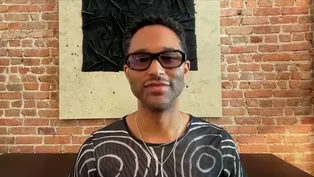
In a Family of Black Cops, an Author Confronts His Race and Identity
Video has Closed Captions
Wilbert Cooper discusses his book "The Black Shield." (17m 28s)
Providing Support for PBS.org
Learn Moreabout PBS online sponsorship New Episode
- News and Public Affairs

Top journalists deliver compelling original analysis of the hour's headlines.
 New Episode
- News and Public Affairs

Today's top journalists discuss Washington's current political events and public affairs.
 New Episode
 New Episode
 New Episode
 New Episode
 New Episode
 New Episode

 New Episode
 New Episode
 New Episode
Support for PBS provided by: