State of Affairs with Steve Adubato
The impact of news deserts on democracy & local communities
Clip: Season 9 Episode 32 | 9m 56sVideo has Closed Captions
The impact of news deserts on democracy & local communities
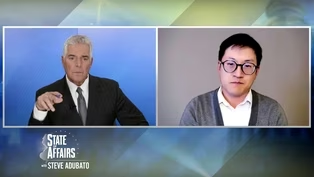
Steve Adubato sits down with Chris Daggett, Board Chair of the New Jersey Civic Information Consortium, to discuss the ramifications of news deserts on democracy and local communities.
Problems playing video? | Closed Captioning Feedback
Problems playing video? | Closed Captioning Feedback
State of Affairs with Steve Adubato is a local public television program presented by NJ PBS
State of Affairs with Steve Adubato
The impact of news deserts on democracy & local communities
Clip: Season 9 Episode 32 | 9m 56sVideo has Closed Captions
Steve Adubato sits down with Chris Daggett, Board Chair of the New Jersey Civic Information Consortium, to discuss the ramifications of news deserts on democracy and local communities.
Problems playing video? | Closed Captioning Feedback
How to Watch State of Affairs with Steve Adubato
State of Affairs with Steve Adubato is available to stream on pbs.org and the free PBS App, available on iPhone, Apple TV, Android TV, Android smartphones, Amazon Fire TV, Amazon Fire Tablet, Roku, Samsung Smart TV, and Vizio.
Providing Support for PBS.org
Learn Moreabout PBS online sponsorship[INSPRATIONAL MUSIC STING] - We're joined once again by Chris Daggett, who is the chairman of the board, the board chair of the New Jersey Civic Information Consortium.
Good to see you, Chris.
- Good to see you, Steve.
- We have the website up right now for the consortium.
Tell everyone what it is and why it matters more than ever.
The graphic will also come up for Media Matters, which is our media series, please.
- So the consortium was formed in 2018 by a bipartisan effort in the legislature, led by a group called Free Press out of Washington, who came and helped get people interested in response to the collapse of local news sites all around New Jersey.
The legislature passed a law that created an independent, nonprofit organization called this consortium, and so we've been in operation since 2018.
- And also, press forward, Dale Anglin, who is the CEO there, checkout our website.
It'll be up right now, SteveAdubato.org.
We did an in-depth interview with Dale, and she provides important perspective here.
So help us on this.
There are a couple of facts that are shocking to me, but not to you because you live this every day.
New Jersey ranks 50th outta 51 states, that includes DC, with only 5.1 local journalists per 100,000 people.
That's horrific.
It creates all these news deserts.
Why is that so bad for the state and our people, Chris?
- Bad because when people aren't informed, they're not engaged in their community.
When civic life is such that people don't participate in what's going on in the activities around them, democracy suffers and the communities are not nearly as successful as they would be with that kind of participation.
- And the consortium provides grants to largely local media organizations.
- Correct, nonprofit and for-profit online, local news organizations, and our focus has been on marginalized communities and so-called news deserts where people have little to no local news whatsoever other than what they might find on Facebook feeds from friends or TikTok or some other social media sites.
- Yeah, talk about that, Chris.
I often pick up my phone and go, "Hey, listen, "somebody on the algorithm team knows what I look for."
Why, Chris, without being overly philosophical or theoretical, if someone said, someone watching right now goes, "Adubato, there's all this stuff Media Matters "and he's got Chris Daggett on, "so many other people, talking about this."
I've got my phone.
I'm on TikTok.
I'm on Facebook.
I'm on Instagram.
They know what I want.
Why is that not, quote, "news," Chris?
- Well, it is a form of news.
I mean, it provides them with some information.
That information has been fact checked or whether it is about the kinds of events in their local communities that may matter to the community and may result in civic engagement, whether it be a new development or something about entertainment in the area or a school board meeting or a planning board or zoning or a town council meeting.
All those are very important, and there's little to nothing on Facebook sites or TikTok sites about those meetings that you would say is news in the sense that it's been curated in some fashion, it's been fact checked, and people are doing anything more than expressing their opinion.
- Chris, you have served in state government in the past, correct?
- Right.
- You understand state government better than most.
New governor, Mikie Sherrill, what, if you were advising her and her administration as to what the state's role should be as it relates to media, public media in the state, but at the same time, not going back to having the state run a public media operation, which was the previous entity, New Jersey Network, who did a great job, but it was a state agency.
Talk about this, Chris.
What should the role of state government be to promote and protect free media in the state?
- So the advertising model, which historically has supported news throughout the state, whether it be broadcast, journalism, or whether it be paper, or whatever it happens to be, collapsed with the rise of the internet, and with that collapse is the collapse of journalism, if you will, and the collapse of local news sites who are supported by that advertising.
So, in my view, public support is necessary, at least until such time as a new financial model to replace the advertising model is developed.
People have been at this for 15 years now.
No one's really come up with anything that's sustainable over time.
They use grants from foundations.
They use membership models.
They use advertising to the degree that they can on the internet.
It doesn't generate that much revenue.
And when you combine all of it, it's still inadequate to support a thriving local news ecosystem.
So I think public support is necessary at least for the probably, not just the near term, but maybe five or 10 years minimum and possibly longer.
And so what does that look like?
New Jersey needs to set up independent entities like the consortium that can provide grants to online local news outlets or other outlets and provide that kind of support that gives them the base to be able to do this important part of civic life, which is letting people understand what's going on in their communities.
- But not control.
See, this is where it gets really tricky, because, and I'm not gonna get political about this, but President Trump has also often called those of us in the media, "the enemy of the people."
And he'll often say, and again, people can like who they like and that's their right, but when the president says he will engage with media organizations that quote, "are nice to him and agree with him," this isn't political, that's not our job to be nice or to like Governor Sherrill or President Trump.
It is our job to be independent arbiters of what we think truth is and facts and have people with different points of view.
Are we supposed to be rooting for the home team here, Chris?
- So, no, we're not supposed to be rooting for the home team, we're supposed to be reporting on what the home team is doing on a day-to-day.
- Last time I checked, yeah.
- And we have this unique opportunity in New Jersey now that virtually no other state has.
We have no commercial television station based in New Jersey.
We have radio stations that are owned mostly by either New York or Philadelphia entities.
- That's right.
- And we have a collapse of local journalism.
But we have an opportunity in this to figure out, because of the fact that the New Jersey public television license that NET held for 15 years has- - WNET, our long time, sorry for interrupting.
WNET, 15 years ago, 2011, with the Caucus Educational Corporation as a key player in that.
The state owns the license.
WNET operated the station, then known as NJTV, then NJPBS, that license, excuse me, that agreement ends on the last day of June, 2026.
The opportunity is what, Chris?
Got a minute left.
- The opportunity is what comes next.
How do you build a public media ecosystem that includes not only the public television, but public radio, local news, how do you put all that together?
And the opportunity is, this is the first time we really have the chance to be shaping New Jersey news as New Jerseyans.
We're not under the shadow of New York with WNET, or the shadow of Philadelphia with its commercial and public television stations, we have an opportunity to do something here for New Jersey, that could be a model for the rest of the country, particularly given the cuts in federal funding for public broadcasting around the United States.
So, the question is how we do that, and that's what's at issue right now, and that's the opportunity that faces, I mean, Governor-Elect Sherrill as she comes into office, - Chris Daggett is the board chair of the New Jersey Civic Information Consortium.
Go on the website, find out more.
And the one commitment I'll make to everyone watching, I've said this many times.
We will, State of Affairs, Think Tank, One-on-One, We will be part of whatever that universe looks like to try to make a difference.
That's our agenda, and I know it's Chris's as well.
Chris, thanks for joining us.
We'll see you next time.
- Thank you.
- We'll continue the conversation.
I'm Steve Adubato.
That's Chris Daggett.
See you next time.
- [Narrator] State of Affairs with Steve Adubato is a production of the Caucus Educational Corporation.
Funding has been provided by The Fund for New Jersey.
The Turrell Fund, a foundation serving children.
Garden State Initiative New Jersey Board of Public Utilities.
PSEG Foundation.
Holy Name.
The Adubado Center for Media Leadership.
Seton Hall University.
And by Robert Wood Johnson Foundation.
Promotional support provided by Insider NJ.
And by NJBIA.
- At the New Jersey Board of Public Utilities, affordability is always top of mind.
We offer a variety of energy assistance and other programs to help New Jersey residents reduce their energy use and save money.
The Community Solar Energy Program delivers immediate electric bill savings to all subscribers regardless of income, and our free Comfort Partners program helps qualified residents save money and make energy efficient upgrades.
We work to put affordability within reach for New Jersey residents.
Addressing the prevalence of childhood poverty
Video has Closed Captions
Clip: S9 Ep32 | 11m 6s | Addressing the prevalence of childhood poverty (11m 6s)

Exploring the societal challenges associated with aging
Video has Closed Captions
Clip: S9 Ep32 | 7m 39s | Exploring the societal challenges associated with aging (7m 39s)
Providing Support for PBS.org
Learn Moreabout PBS online sponsorship
- News and Public Affairs

Top journalists deliver compelling original analysis of the hour's headlines.

- News and Public Affairs

FRONTLINE is investigative journalism that questions, explains and changes our world.











Support for PBS provided by:
State of Affairs with Steve Adubato is a local public television program presented by NJ PBS