Here and Now
US Sen. Tammy Baldwin on the War and Ceasefires with Iran
Clip: Season 2400 Episode 2443 | 9m 24sVideo has Closed Captions
Tammy Baldwin on negotiations on ceasefires amid hostilities in the Strait of Hormuz.
U.S. Sen. Tammy Baldwin, D-Wisconsin, discusses negotiations between the United States and Iran on ceasefires amid hostilities in the Strait of Hormuz as well as her priorities for a new Farm Bill.
Problems playing video? | Closed Captioning Feedback
Problems playing video? | Closed Captioning Feedback
Here and Now is a local public television program presented by PBS Wisconsin
Here and Now
US Sen. Tammy Baldwin on the War and Ceasefires with Iran
Clip: Season 2400 Episode 2443 | 9m 24sVideo has Closed Captions
U.S. Sen. Tammy Baldwin, D-Wisconsin, discusses negotiations between the United States and Iran on ceasefires amid hostilities in the Strait of Hormuz as well as her priorities for a new Farm Bill.
Problems playing video? | Closed Captioning Feedback
How to Watch Here and Now
Here and Now is available to stream on pbs.org and the free PBS App, available on iPhone, Apple TV, Android TV, Android smartphones, Amazon Fire TV, Amazon Fire Tablet, Roku, Samsung Smart TV, LG TV, and Vizio.
Providing Support for PBS.org
Learn Moreabout PBS online sponsorship>> This week there have been dizzying developments in the war with Iran.
Midweek, the US called the war concluded, moving instead to Project Freedom to open the Strait of Hormuz.
But President Trump quickly quit Project Freedom.
Now both sides are considering a peace plan in the midst of an uneasy ceasefire.
How to make sense of this even as the price of oil goes up and down with mixed messaging while the price at the pumps stays high?
Democratic US Senator Tammy Baldwin is here, and thanks very much for being here.
>> Thank you for having me.
>> So, with all that's happening, what in your mind is the best outcome?
>> The best outcome would be for the war to come to a quick end and to use diplomacy to settle the issues.
I always have to remind folks that in 2015 there was an international agreement that would have prevented Iran from developing a nuclear weapon.
There were intrusive inspections.
And Donald Trump in his first term as president ripped it up.
I think we may end up in this conflict with a deal that's less robust than the one that was agreed to in 2015.
Look, diplomacy is the answer, and instead, Donald Trump has brought us into a war of choice.
And I emphasize that point because we were not under attack from Iran.
We were not under imminent threat of attack.
And in those circumstances, the president needs to come to Congress to authorize use of military force.
He didn't.
So now we have 13 service members dead, we have hundreds more injured, some very seriously, and we see these price shocks with gasoline, with fertilizer for our farmers that are just getting ready to plant.
I've been a part of an effort with a number of colleagues to force votes on war powers resolutions.
And we are gaining support over time from our Republican colleagues, but that's what we need to do, is bring this to a quick end and use diplomacy to achieve our goals.
>> Do you feel as though the administration is skirting the War Powers Resolution by declaring this war concluded, terminated, over?
>> I heard just a week ago the Secretary of Defense say, "Well, you can't toll the days that we've been in a ceasefire, those don't count as part of the 60 days that the War Powers Act references."
But regardless, they are, we are currently in hostilities.
We are clearly in a war and it is an unmitigated disaster for the US and the global economy.
>> Because you were just describing the best case outcome, what would be the worst?
>> The worst is that we end up far less secure as an economy as well as a nation because of this war of choice, this illegal war of choice.
You know, and while it's not tangible, the damage it's doing to the rule of law in this country is worth noting.
>> What are your constituents saying about what it means for them here at home?
>> Well, I'm hearing mostly about the costs.
We have had the highest cost really ever on average for gasoline at $4.50 on average across the state.
Farmers are really reaching out to describe the shortage of fertilizer as well as the high price if they can source it.
This will affect what they're able to plant this year.
And, you know, that's all on top of the president's previous trade wars that have cut off markets for our farmers and have really jacked up the cost of input.
So, I would say overwhelming opposition to the war, but mostly articulated by folks who are just feeling the squeeze.
And they were all already feeling the lack of affordability prior to the war beginning, this has just double down on that.
>> Saying all of that, how do you think the war in Iran affects the midterm elections?
>> I think that people will be more likely to vote for those who have opposed the war and have taken actions or spoken out against it and have articulated that they will be a check and a balance to this president, not, you know, not somebody who just loyally goes down whatever path he takes us.
>> So, we were just talking about agriculture and fertilizer and inputs for farmers.
The US Senate is poised to take up the Farm Bill after the House passed the $390 billion version of it.
What are your priorities for the Farm Bill for Wisconsin?
>> Yeah.
Well, looking at the bill that was passed by the House, I realized that it doesn't really respond to the enormous headwinds our farmers are facing.
Look, they're the hardest working people I know, supplying food for not only the country but the world, and the Farm Bill needs to address those challenges.
One of the things that makes the House-passed bill really a non-starter in the Senate is the refusal to restore some of the nutrition funding that was cut from the president, what he calls his One Big Beautiful Bill Act.
It doesn't restore the $186 billion that was cut out of the SNAP program.
And that is something that brings folks together in terms of farm policy.
But in the terms of my priorities, the Dairy Business Innovation Act is one that I got in the last Farm Bill.
It's been so successful for dairy businesses to grow and improve their bottom line, and I wanna see increased support for that.
The House-passed bill does not include my Healthy H2O Act, which helps folks in rural areas check their water for PFAS and other contaminants, things that they really can't afford to do without some help.
And also the Farmers First Act.
Farmers, because of the stresses, financial and otherwise, that they face have high rates of suicide, and so this is a mental health program that helps reduce that stress and helps make sure that there are support groups locally for them to turn to.
>> How difficult will it be to pass the Farm Bill?
>> I think that we can craft a bill on the Senate side that is bipartisan and that foresees what will be necessary to garner the bipartisan support necessary to pass a bill.
You know, we see this over and over again in the Senate, you need 60 votes to pass a Farm Bill.
In the House, it's a simple majority, so they can write a partisan package and pass it.
But we need to write a bipartisan package that really addresses the challenges that we're hearing from our farmers.
>> On disaster aid, we know that Governor Evers reached out to Wisconsin's congressional delegation for help getting more than $26 million in federal disaster aid to fix infrastructure after last summer's floods that the president had denied.
What inroads is our delegation making into recovering that aid?
>> Yeah, I mean, certainly I was pleased that the administration approved some of the grants for personal loss, that individual losses that were faced.
But for the public infrastructure, they turned it down, and I see no reason for that.
In fact, I'm concerned that there were politics involved.
Meanwhile, we have a new set of tornadoes and flood damage that has just happened in the past month and we need to work with the administration to make those citizens and communities whole as best as possible through work with FEMA.
You know, the president came into office pledging to abolish FEMA.
He hasn't succeeded in that.
We understand that there is a role for the federal government in emergency management and emergency relief and we need to hold them accountable to that.
>> Alright, we will see.
Senator Tammy Baldwin, thanks very much.
>> Thank you.
 New
NewHere & Now opening for May 8, 2026
Video has Closed Captions
Clip: S2400 Ep2443 | 1m | The introduction to the May 8, 2026 episode of Here & Now. (1m)
 New
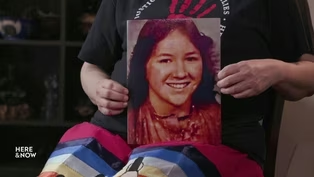
NewOne Menominee Nation Family's Story of Tragedy and Advocacy
Video has Closed Captions
Clip: S2400 Ep2443 | 6m 1s | Advocates and family gathered at a rally to honor missing and murdered Indigenous women. (6m 1s)
 New
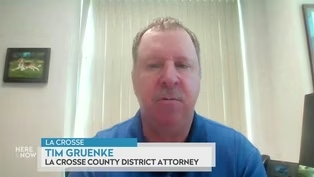
NewTim Gruenke on Investigating Animal Welfare at Ridglan Farms
Video has Closed Captions
Clip: S2400 Ep2443 | 6m 51s | Tim Gruenke on an investigation of the Ridglan Farms dog breeding and research business. (6m 51s)
 New
NewAlex Gee on Sustaining Madison's Black Community and Culture
Video has Closed Captions
Clip: S2400 Ep2443 | 6m 6s | Alex Gee on opening a facility to celebrate African American communities and culture. (6m 6s)
Providing Support for PBS.org
Learn Moreabout PBS online sponsorship
- News and Public Affairs

Top journalists deliver compelling original analysis of the hour's headlines.

- News and Public Affairs

Today's top journalists discuss Washington's current political events and public affairs.











Support for PBS provided by:
Here and Now is a local public television program presented by PBS Wisconsin