
Week in Review
Week in Review Extra: Talking Trees
Clip: Season 33 | 26m 46sVideo has Closed Captions
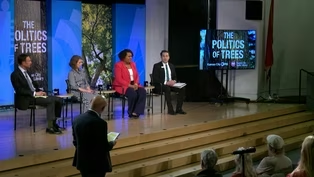
Nick Haines and a panel discuss issues raised in KCPBS’ The Politics of Trees.
Nick Haines convenes local policymakers, developers and environmental advocates to dig into the thorny issues raised in the Kansas City PBS documentary, The Politics of Trees. The public also weighs in, directly questioning decision-makers in a candid exchange about tree loss, extreme weather and the ongoing tug-of-war between rapid development and protecting Kansas City’s shrinking tree canopy.
Problems playing video? | Closed Captioning Feedback
Problems playing video? | Closed Captioning Feedback
Week in Review is a local public television program presented by Kansas City PBS
Week in Review
Week in Review Extra: Talking Trees
Clip: Season 33 | 26m 46sVideo has Closed Captions
Nick Haines convenes local policymakers, developers and environmental advocates to dig into the thorny issues raised in the Kansas City PBS documentary, The Politics of Trees. The public also weighs in, directly questioning decision-makers in a candid exchange about tree loss, extreme weather and the ongoing tug-of-war between rapid development and protecting Kansas City’s shrinking tree canopy.
Problems playing video? | Closed Captioning Feedback
Where to Watch Week in Review
Week in Review is available to stream on pbs.org and the PBS app.
Providing Support for PBS.org
Learn Moreabout PBS online sponsorshipAnd you've been watching The Politics of Trees right here on Kansas City PBS.
Hello, I'm Nick Haynes.
As you've been watching at home, we've been watching here at the Kansas City Plaza Library with many of your friends and neighbors and with us and some of the experts and the filmmaker himself, Michael Price.
Also with us is Sarah Crowder, who you saw in the film.
She's a certified arborist, urban forester and director of operations at Bridging the Gap.
And we have decision makers from both sides of state line.
City Councilwoman Melissa Robinson is one of the 13 votes that control everything in Kansas City.
She's also the president of the Black Health Care Coalition, is now stepping in as president of the Urban League.
And you still found time for us?
Yes.
Thank you very much.
Also with us from the largest city on the Kansas side, Overland Park City Councilman Logan Healey, who juggles complaints about potholes, trees being cut down.
And up until last fall, complaints from residents anxious about whether the royals will move to his city.
That's what he does every night and weekend.
But during the day, I like that we get to that in a moment.
He's executive director of the Heartland Conservation Alliance.
We also have a fifth panelist, and that is you come to the microphone at any time.
We're going to take your questions as well during the course of this experience.
But Michael Price, this is the 12th film you've done for us, the 12th documentary.
What was the biggest unexpected surprise that you learned along the way?
Having spent pretty much the last year review life working on this?
I'd say it's probably my discovery as to how much trees actually do for us.
Trees.
As it says in the film, they help clean our air.
They help bring shade to our neighborhoods.
They help reduce the amount of stormwater runoff as well.
They do all of this for us.
There's some maintenance involved, of course, but by and large, it's free.
The second thing, which was a revelation to me, if I may, Nick, is this idea that in our area we have these vast forests, we have them in the, in the South Rim, Ramona Park, and they're in Swope Park in the east, and then the Lying Creek forest in the north.
And we should think of these forests and the services they provide.
They're like the, the if you can put it this way, the lungs of the of Kansas City, Missouri, and this is something else you learned along the way, of course, is every time you were out talking with people is how much people absolutely love their trees.
And that's shown here with such a packed audience with us at the Plaza Library.
They do.
It's, I've made lots of films here in Kansas City about various things.
But I've never made a film.
Syngenta.
So much passion.
People love their trees to the point, as you saw in the film, where they name their trees, they regard their trees as their friends, and they, they care a lot about them, whether that trees in their private yard or down the road in a wood.
Sarah, the biggest take home from the documentary for me was actually one of your quotes, which was in Kansas City, Missouri.
There are no penalties on developers who cut down less than one acre of trees.
Correct.
That ordinance currently says you have to have one acre of contiguous forest.
So that's a pretty good sized chunk of trees.
Were you surprised by that?
Yes.
Yes, absolutely.
So tell Melissa Robinson I sent you one of the 13 votes that controlled everything in Kansas City.
Why that one acre then?
It's not a really high trigger point.
It is.
And, if I would have my druthers, obviously, we would have a stronger ordinance.
Anything that supports sustainability that helps us to achieve our climate protection goals.
We need we're in trouble.
And it's really good to see everyone here tonight because, you know, you know that you're not alone, that we know that we're in trouble together.
We need to make a difference and to make a change.
This was an ordinance that had a lot of negotiation.
And in Kansas City, developers have a lot of power.
And we have to begin to shift that power to the people.
Okay.
So what power then, do developers have that the people in this room do not have?
What is their super power that all of these people here do not have?
It is their presence.
This room is a beautiful room.
Having these same individuals show up to city council when we're making these votes would be extremely powerful.
Having those conversations, letting us know how many people in your neighborhood are registered to vote.
And that will be making decisions with at the ballot box.
But are you worried, though, if you had a tighter ordinance that home developers, as we just saw in that video from Michael Price, we'll just vote with their feet.
They'll just build over in Overland Park or another casino.
I, I don't buy into that.
I buy into a council that has a vision for growth.
On the east side, there are a lot of houses that need to be, rejuvenated, that need to be rehabbed, that we can we can still achieve the unit, the units that we need to achieve by looking at the existing stock without tearing down and removing our, urban, poor street.
I want to get over to the Kansas side in just a moment.
We can go to a little bit in just a moment, but I really could.
You put us out of our misery because we have been learning.
For instance, if Kansas City wants to pat itself on the back for loving its trees.
Why is the city so intent on tearing down, cutting down hundreds of mature trees in Washington Square Park to build them all?
Talk?
That to is an awesome question.
I do believe, according to the information that I have, that a lot of those trees won't be impacted because we're looking they're looking more for the the Crown Center district and not the Washington Square Square Park.
Well, Logan Healy, remember in Overland Park where they wanted to build the bold talk, was considered on the former sprint campus there.
And if you recall, also, the city of Overland Park just rebranded, having what we were told is one of the ugliest flags in the country.
They put a tree on the flag because that's how important it was to you.
But yet, if you drive by the sprint campus today, the former Sprint campus, people are getting angry at all of the trees that are being torn down there to put in all these new developments, from Andretti's race car tracks to Freddy's restaurants tearing down all of those trees there, how does that fit with that branding?
Putting the tree on the flag when that's happening?
Well, I appreciate oh wow, allowing you love trucks, allowing me to flag wave our flag.
Yeah, I, we wanted, the Red Oak, which is our city tree on our, on our city flag because we are overland Park Park is part of our name.
Very few cities across the country have park in our name.
But I would say that we also have, I'm flying our flag, but we have a lot of room to improve when it comes to tree preservation and mitigation.
And it's not just the spirit of campus.
It is all of the, you know, beautiful natural areas that we have in the southern part of our city.
It's also the tree canopy that we're losing in the northern part of our city.
And so we certainly, I know the documentary folks focused a lot on the Missouri side, but, and it's not just Overland Park, but across the metro.
We have a lot of work to be done on stronger tree preservation and mitigation ordinance.
We've been talking to a lot of cities and residents of different cities throughout the course of making this film, and it seems like a development that can can basically come in and they can bring down the trees if they plant, you know, a couple of saplings in a in a different location.
We call it about.
Right.
But, you know, when you have 30 year old trees, Sarah, you know, how many of those saplings does it take to get the type of benefits that Michael is talking about?
If trees are about improving our health, cooling us neighborhoods?
I mean, is that an even trade?
No, it's not.
To get that immediate benefit, we'd be talking about 100 hundreds of trees, right?
Because of the size of the canopy and the in the trunk.
But probably what?
That it's not always feasible.
15 to 20 trees potentially.
Right.
And over 20 some odd years, maybe they would finally reach that.
But what we're dealing with is more mortality.
So if we're not actively maintaining those trees, then they may not reach that potential.
We spoke about two weeks ago at the station.
They had an international tree expert come to Kansas City from Amsterdam.
And one of the things she said to me during an interview was even to start seeing the health and cooling effects of a tree.
They have to be a teenager.
Tree has to be a teenager.
Yet we also told the majority of trees in urban areas don't live beyond 13 years old.
So?
So why is that?
Well, that study, is addressing trees that are in more of our dense, dense, urban areas.
But so we're dealing with heat.
We're dealing with, low soil volume.
The tree has to have a place to grow.
We're dealing with water and our changing heat, temperatures, climate, lack of rain and all of those things.
Yes.
One of the things that we saw from the documentary, you see a lot of people, who are saying how much they love their trees and you can see it in their neighborhoods.
And as Michael points out, many of them in an upscale neighborhoods, you know, if you're in a lower income part of our city, are you getting the same benefit from those trees?
And are they maintained the same way?
And is the city planting the same number of trees, for instance, in your district?
Melissa Robinson We are looking at it from an equitable approach, but it does take organizations, that are here on this stage to hold our feet to the fire, to make sure that we're doing things in an equitable way.
Just as a kid, I remember a big tree on the corner of 3030 third and Jackson where I grew up, and I would sit and dream, you know, and with my little catalog, looking through all the things that I'm going to buy, when I get money, when I grow up.
And so, yes, trees mean a lot to everyone, that have the opportunity to experience them.
But especially in the areas on the east side, when you think about the, exacerbation and the disparities regarding asthma, especially childhood asthma.
And we know, from a city's perspective, how important trees are, because we're building a $300 million deck over our 670, because it's more populated.
And we know that the health issues with the highway are having a negative effect.
And so we're having to build more green space.
But in the urban area, it is more important because of the urban heat island, because of the amount that people have to spend on their energy bills.
Those trees provide, that protection, to help, cool their homes.
And so when we're looking at it from an equitable standpoint, I think it is important for us to center the urban community.
I have got tons of questions here, but I would stop the action at any point.
If you have a question of your own, come to this microphone.
Everyone says plant more trees, but only planting the right ones.
And are we doing enough to keep them alive?
Overland Park Logan used a lot of its federal Covid money to replace more than 3000 trees that had been infested with that sort of emerald ash borer that we now know about.
But according to the Johnson County Post, city leaders in Overland Park worried all those replacement trees aren't getting the proper care and could die.
So we did all that work.
Who spent all that money?
What went wrong?
Well, it hasn't gone wrong yet.
Okay.
There's still time.
But I mean, what, we.
If you take out the federal funding that we recently put into our ash tree program, our per capita spend on urban forestry in Overland Park is half the statewide average in Kansas.
And I'm not sure the statewide average in Kansas is really where we want to be as a Tree City USA either.
So I think for us going forward, we need to make sure that we are funding our forestry efforts appropriately.
We have an upcoming urban forest master plan that is, we just got the first draft to the tree board on yesterday, Monday.
That calls for a whole lot of different new efforts for the city and enhanced efforts for the city and taking care of all those new trees that we diversified our canopy with while while mitigating the emerald ash borer.
Problem is going to be really important because those are street trees.
They are supposed to be privately maintained, even though they are in the public right of way.
And I personally would like to see, the city take a more proactive approach to our street trees.
Treat them and all trees really as critical civic infrastructure.
I think that's, probably a big part of this documentary.
The thesis is trees are infrastructure, that we should treat them as infrastructure.
I'm going to get into that in a moment.
But we have some terrific people with us who have their own questions.
Briefly, I want to say that I commend the city and government for planting trees, but we have to make sure we water them after they're connected.
Yes.
I love this.
This is going to get where we're going to go next.
This is important, isn't it?
It is.
But I do want to say, as a as a homeowner in the Voelker neighborhood, which has beautiful mature trees, the cost of maintaining those trees is exorbitant.
So is there any hope from any organization or the city to get help to maintain those trees?
I have a friend that spent $10,000 to remove a mature tree.
And why would anybody plant a tree if you got to that?
This is perfect.
Who's got a response to that?
First of all, as we plant a lot of these trees, especially street trees.
We are requiring residents to put some skin in the game to let us know that they're going to help nurture the tree, at least for the first three years.
But we do have to look at how are we using things like, you know, rain barrels and other other green technology to help us?
Address the issue.
I know people in Overland Park who are with seniors on fixed incomes who have left the city because they couldn't afford Logan, to take care of the trees.
Something happens with a tree.
It's going to cost 3 or $4000.
They.
It was all of these unexpected costs.
Is there any sort of sense of cost sharing with residents if trees are so important?
Is there any program to help residents keep the trees they have?
Not currently, but I think that gets back to we need to start treating trees as city infrastructure.
Well, we've actually got some funding right now.
It's about to run out, but we got some federal dollars and we've been piloting a project to remove, dead ash trees in particular in a in a neighborhood.
We're about to run out of that money.
We wanted to pilot it, see how it works.
It can function.
We just have to find that funding mechanism.
Another part of this.
Back to the gentleman's question, really, are developers, being asked to, to also, maintain the trees?
Does the Kansas City, for instance, hold these developers accountable five, ten years down the road to see how many of those trees actually survived?
Or are we just satisfied that the tree was planted?
We provide $100 million in tax incentives that we don't have any clawbacks on.
So for trees, no, that would be a no.
So if we're not if we're not, holding folks accountable for the actual taxes, that they're okay, there is no the answer is no.
So they can plant the tree and nobody cares after that.
And Logan in Overland Park, I'd say it's a challenge across the metro for enforcement of landscape plans, which are supposed to be, held in perpetuity.
I mean, if if we required 30 years to go to plant a tree, it's it's supposed to be there.
But enforcement, across the metro and including Overland Park, we don't go back and check, and we'd have a whole lot more trees across our community if we did go back and check.
Yeah.
Michael, the way that the Kansas City or tree Preservation Ordinance works is to say if you chop down an acre of trees you have to plant, you could get away with planting 26.
Well, how many trees are on an acre?
Considerably more than 26.
Anywhere from between 100 to 600.
I think that is one.
Is the city planting the trees?
The city should be educating people on what needs to be done to maintain those trees.
Yes.
How to water the trees, when to water the trees.
And I think you'd find that residents would take that upon themselves if they knew to do that.
So we can do something, for example, that fairway does very well in the documentary.
You mentioned that by 2053, we are projected to see in Kansas City heat indexes about 125 degrees.
Are we planting when we you know, the planting the trees right now are our cities and your own organization do any planting for today or for the temperatures that we're going to be experiencing 30 years from now, less than 30 years?
We're definitely exploring tree species that you might find more in the Oklahoma or southern parts of Missouri Range.
It's a slow process, so we're not exactly jumping into that, but we are trialing that, and so is the city parks department.
In fact, at home, you may want to be considering trees that are currently native to Buenos Aires or Ecuador to because of the climate change.
Sir, you've been very patient.
Your question please.
Hello, my name is Jeffrey Johnson.
I'm 17, and, sometimes I walk from my school all the way down to this beautiful library.
And sometimes I see these trees that are super overgrown.
And the roots have basically taken over the sidewalk.
And so, that has led to a loss of accessibility for sometimes me or, sometimes meeting with my neighbors who have, accessibility issues.
And so what I'm basically saying is that would you value, cutting down a tree within that neighborhood to sacrifice, accessibility?
You know, typically, I think we blame the tree for the mobility issues and tearing up the sidewalk and that sort of thing.
And really, it's it's because humans, planted the wrong tree or they planted it in the wrong place or planted it the wrong way, not allowing it enough space to to move.
So it's a delicate balance, I think.
There, there, you know, innovative ways that people have been able to do both.
And, but, but, you know, it's a, it's a delicate balance.
And the best thing is, is to do it right the first time.
So what is the most over planted, overrated tree in our area, Sarah?
Red maple.
Kelly Daniels and, I currently live in Overland Park.
I broke my house 33 years ago.
And, on the headwaters of the blue River.
And I've watched as I've lived there.
Overland Park, the city of trees.
Let developers clear cut entire forests, old growth forests across from me.
Is there anything in Overland Park that you're, planning on for tree preservation for these, these developers that are completely annihilating all the trees?
It's it's a great point.
I what it comes down to is getting a majority of the governing body in the mayor to support strong tree preservation.
And, once you have a tree on your flank, they would automatically go for it, wouldn't they?
It's almost like sometimes politicians, do things for show.
But, But, that's the tease for our program.
But but, Kelly, I appreciate what you do in your question, and, I it takes the people in this crowd.
It takes the people watching to, let their local government know what they want when it comes to trees.
There's been a mark model ordinance for tree preservation and native plant encouragement to the earlier question.
Since 2020 or 2021.
And I think Kansas City, Missouri is the only one that's taking a look at it across the whole metro.
And so it takes, residents, community members to just hammer folks.
We have open public comment at every city council meeting.
Frequently those people don't ever come to those said they don't work so well.
I beg to okay.
And they, they it's kind of a show, by the way.
You can check out the five things you're probably doing wrong in your own yard in planting trees.
Kansas City, pbs.org, and our website.
You can also join for a day a tree trimmer.
And they climb the trees.
And it's a really dangerous job.
You can see that video also at Kansas City pbs.org backslash politics of trees.
Not a I mean, I think the city needs to make it a priority with other people who are digging holes and laying electric lines and pipes, that it's really critically important that they preserve the trees while they're doing that.
I saw I saw spire doing some work on Linwood after I personally, with some friends planted 15 trees, and I just would like to know what the city does to try to make it clear to people who dig holes that preserving trees is a high priority here.
Is there any coordination?
I would say no for the tree for regarding preserving our tree canopy now.
And we do need to have more.
We need to change our mindset as it looks at trees, as infrastructure.
And it does need to people need to be held accountable, and trained on how to do it.
Because I don't think that our contractors are trained on how to preserve the trees.
And that's what really infuriates residents, though, isn't it?
Yeah.
And I would say that, at least in the state of Kansas, probably in Missouri too, the utilities have a lot of ability to do things without any notice to the city, within that right of way.
But with our utilities and also with developers, I mean, I think of it as comparing of a, mature, healthy tree to a brand new street.
If a utility company or a developer or home builder comes in and tears up a brand new city street, we're going to make them replace it.
And we ought to do the same with a mature, healthy tree that they destroyed.
Okay, well of course, thank you, thank you, thank you very much, Sharon, for all of us at home, what is the biggest mistake we make in our own yards?
I would say right tree, right place was commented.
So know and understand the space that you want to plant your tree, but also do your research.
You might go into a nursery and you're, given the choices that they're selling, that's their fastest selling tree.
That may not be the best tree.
So figure out what you want and then go looking for it, not what they have to offer on sale.
If everybody did just one thing differently after this conversation, what would it be?
Michael, if every viewer did one thing differently?
Yes.
My goodness, didn't want it to be.
I would say, get out into those forests, get out and explore some of those forests that we are fortunate enough to have in Kansas City, Missouri.
They're amazing places.
What a treat it was to go around that forest on that Saturday morning with our go about who you see in the film, and that enormous stacks stood up.
I mean, these things are unforgettable.
Take, take.
You know what was unforgettable to me from that film?
Your poet David, and he said, hey, this world I just have on David stand up for us.
I just love this.
I just you I saw you really.
I don't live in the trees face.
It was just such a wonderful I did.
Just amazing.
Thank you.
Michael said it all.
Get out in the woods.
All righty.
Thank you.
Sarah.
The one thing that people should take from this conversation that they would do differently.
What would it be?
I would say from this, they should take this energy and this excitement.
Learn more about trees.
If you're not advocating to your council members, maybe you're talking to your neighbors about things that you're seeing and and learn from each other.
I'm Melissa, you will be giving your private cell phone number to everybody in the limit so we can talk to you directly about trees, right.
And influence Kansas City.
Yes, definitely.
Come to the City Council on Tuesdays and Thursdays.
Our meeting start at 9 a.m.
on Tuesdays, and you can just stop in and talk to council members about the importance of of trees.
On Thursdays at 2:00.
I know that those aren't opportune times, but we definitely need to be organized and raise the level of awareness.
And the last one goes to Logan Healy, our councilman from Overland Park.
Find out who your city council members are.
Find out who your mayor is.
Email them.
Attend a city council meeting.
Speak it.
Open public comment if your city has it.
A lot of cities also have tree boards, you know, so attend those meetings.
Those are open to the public.
And, you know, reach out to great organizations like Heartland Tree Alliance about how you can help as well.
And on that, we will say, you've been watching The Politics of Trees with Michael Price and Sarah Crowder and from elected politics, Kansas City Councilwoman Melissa Robinson and Overland Park Councilman, Logan Healy.
And I'm Nick Haines from all of us here at the Kansas City Plaza Library.
Be well, keep calm and carry on.
Support for the politics of trees is made possible by the William T Kemper Foundation, Commerzbank trustee and the generous financial support of viewers like you.
Thank you.
 Now Playing
Week in Review Extra: Talking Trees
Video has Closed Captions
Clip: S33 | 26m 46s | Nick Haines and a panel discuss issues raised in KCPBS’ The Politics of Trees. (26m 46s)
A Frank Decision: Jackson County’s Historic Recall Vote
Preview: S33 | 15s | Join us at the Plaza Library for "A Frank Decision" community town hall event. (15s)
Providing Support for PBS.org
Learn Moreabout PBS online sponsorship New Episode
- News and Public Affairs

Top journalists deliver compelling original analysis of the hour's headlines.
 New Episode
- News and Public Affairs

FRONTLINE is investigative journalism that questions, explains and changes our world.
 From My Station
 New Episode
 New Episode
 New Episode
 New Episode
 New Episode


 New Episode
 New Episode
Support for PBS provided by:
Week in Review is a local public television program presented by Kansas City PBS